
News · · 9 min read
Gemini Decisions API: an endpoint that returns probabilities instead of text, and how it differs from Jev and OpenAI
In this post
On November 11, 2026 (US time), Google opened the Decisions API in the Gemini API, along with a model built only for it: Gemini Decision 1 (gemini-decision-1). The API does not generate text. It answers yes/no, multiple-choice, and rubric questions with probabilities and a confidence score. TypeSafe's Jev and OpenAI's Decisions API (GPT-6 Luna) were already in this space, so Google is the third entrant. Put the three vendors' docs side by side and Google's clearest lead is not accuracy but input types: Gemini Decision 1 is the only one of the three that accepts audio and video, and the only one whose docs list PDF input. Accuracy depends on who measured it. In Google's own table it ranked first on 7 of 9 benchmarks (two of which have no Jev or Luna score); on the third-party Artificial Analysis index it tied Jev 1.14 at 66.
This post covers what the Decisions API returns, how the three decision APIs differ on paper, where Google's numbers and the third-party numbers part ways, how developers reacted, and what to check before putting it into a product.
An endpoint that returns probabilities, not prose
When code only needs to branch, as in routing or policy checks, using a generative model means getting an answer back as text and parsing it. The Decisions API removes that step. One request carries a shared input and a list of questions, and each question gets a typed answer. Google's docs define three question types.
| Question type | Used for | Returns |
|---|---|---|
noul (yes/no) | Checking whether a condition holds | Probability of yes, 0.01–0.99, plus confidence |
choice | Picking one option from a fixed list | Chosen option, per-option probabilities, confidence |
score | Grading against an ordered rubric | Probability-weighted level, per-level probabilities, confidence |
A single request can hold up to 1,000 questions, and all of them are scored against the same input in one forward pass. According to the docs, questions cannot see each other, so adding or removing one does not change the other answers. The shared input and all questions together are limited to 262,144 tokens. Output tokens are always zero, so only input is billed, at $0.10 per million tokens.
Latency figures come from Google alone. Google says median model compute is 50–100 ms and end-to-end latency is 150–250 ms for inputs up to 16K tokens, staying nearly flat from 1 to 100 questions per request. Google also says that across its shared benchmark suite the API is nearly 5x cheaper than running Gemini 3.5 Flash-Lite through the Interactions API (minimal). Dividing the two totals in Google's table, $4.14 by $0.88, gives about 4.7x (our calculation).
The docs also list what is missing. There is no context caching, no Batch API, and no Flex or Priority inference, so the same input sent across several requests is billed in full each time. Conversation history and tool-call blocks are not accepted as input, and question instructions must be text.
The three decision APIs on the same rows
We compiled the following from each vendor's official documentation, using the same rows for all three. Prices are per million input tokens; none of the three bills for output. OpenAI's $0.10 is the base rate for uncached input, and its docs say regional processing premiums and long-context input multipliers apply on top.
| Item | Gemini Decision 1 | OpenAI (GPT-6 Luna) | TypeSafe Jev 1.14 |
|---|---|---|---|
| Input price | $0.10 | $0.10 (base rate; discount on cache hits) | $0.042 |
| Input types | Text, images, audio, video, PDF | Text, images, JSON | Text, images (images not yet production-ready) |
| Questions per request | Up to 1,000 | Up to 400 | No set count (within context limits) |
| Context | 262,144 tokens | Not stated | Default 64,000 per request and 32,000 per question; 262,000 with an opt-in header |
| Item | Gemini Decision 1 | OpenAI (GPT-6 Luna) | TypeSafe Jev 1.14 |
|---|---|---|---|
| Prompt caching | Not supported | Supported | Not found in docs |
| Conversation and tool-call input | Not supported | Supported | Not found in docs |
| Access path and processing region | Gemini Developer API (v1beta) only; no Vertex AI | Regional processing in the US and Europe (EEA + Switzerland) | Not found in docs |
| Status | Newly launched | Generally available | Released Oct 14, 2026; images not production-ready |
Taken together, the three occupy different positions. Jev is cheapest per token. OpenAI documents the most operational features: caching, conversation input, and regional processing. Gemini Decision 1 leads on input types and on how much fits in one request by default. Jev can be raised to 262,000 tokens with an opt-in header, but TypeSafe's docs say that mode is slower and less accurate than the default limits. That is why Google's launch post uses examples such as pairing a call recording with account metadata, or a scanned PDF claim with damage photos.
Where Gemini won and lost in Google's table
Google's launch post includes a benchmark table comparing Gemini Decision 1, Jev 1.14, GPT-6 Luna (OpenAI Decisions API), and Gemini 3.5 Flash-Lite on nine benchmarks. For the seven where Jev and Luna both have scores, we calculated the gap between Gemini Decision 1 and each rival.
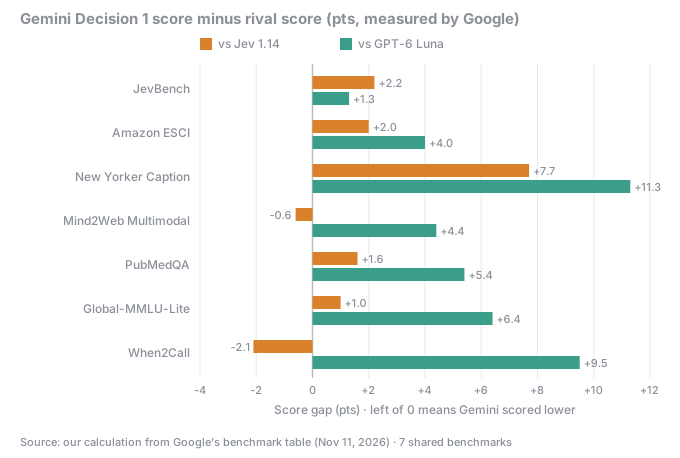
Gemini Decision 1 beat Luna on all seven. Against Jev, most gaps are one to two points, and it lost twice: 86.2% vs 86.8% on Mind2Web Multimodal, and 79.9% vs 82.0% on When2Call, which tests whether a model should call a tool. Tool selection is the first use case Google lists in its launch post, so trailing Jev on exactly that benchmark is worth noting. The largest gap was New Yorker Caption (text-only), where Gemini scored 7.7 points above Jev.
The cost row in Google's table also favors Jev. Running all seven shared evals cost $0.88 with Gemini Decision 1, $0.68 with Jev, and $0.93 with Luna. On calibration, which measures how well the stated probabilities match actual accuracy (Top-1 ECE, lower is better), Gemini Decision 1 scored 0.0250, about half of Jev's 0.0494. Every number in this table was measured by Google.
A third-party index puts it level with Jev at 66
The third-party measurement available is Artificial Analysis (AA) Decision Index v2.1. AA scores decision models on a common index, as accuracy minus the Brier score of the stated probability. We collected AA's figures for the three models into one chart.
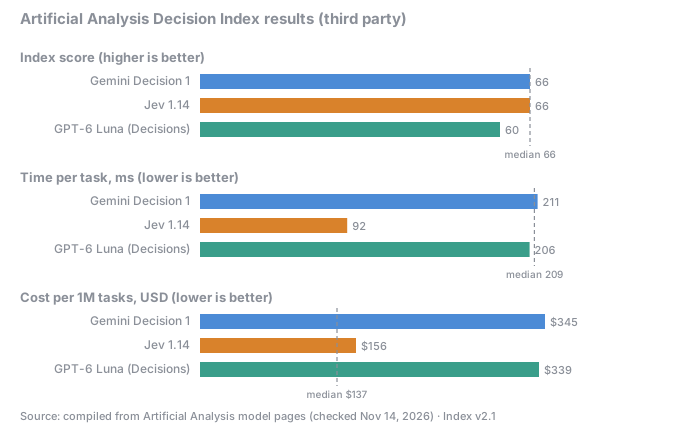
Gemini Decision 1 and Jev 1.14 both score 66; GPT-6 Luna scores 60. The "first on seven benchmarks" story from Google's table becomes a tie with Jev on the third-party index, at the same score as AA's median for decision models. Speed and cost show a wider gap. Time per task is 92 ms for Jev and 211 ms for Gemini Decision 1, and cost per million tasks is $156 for Jev and $345 for Gemini Decision 1. AA puts the decision-model median at 209 ms per task and $137 per million tasks, and on cost it labels both Gemini Decision 1 ($345) and GPT-6 Luna ($339) expensive.
Why the two measurements disagree has not been established. The benchmark sets differ, and AA's index includes no audio or video evaluations. Audio and video input, the feature that sets Gemini Decision 1 apart from the other two, has no third-party measurement yet.
Hacker News reaction
The Hacker News thread on Google's announcement drew more than 160 comments. User Topfi reported results from a quick personal eval: "many usage scenarios a 4x lower brier over Jev (2x - 6x depending on task)". The same comment added that "all this cost twice as much across the entire eval end-to-end."
User muzani focused on input types: "This appears the first decision AI that actually handles audio, video, and PDF". The same user also wrote that "Jev is still faster and cheaper for many of the common text uses." Others questioned the price. User flockonus wrote, "At 0.10/M this feels very overpriced vs Liquid's 0.02/M."
The API design drew criticism. User vintermann pointed out that Google uses Jev's term "noul" without mentioning Jev. User holografix called it "a solid but not great 'we do it too' product." User vesterde asked when it would reach Vertex AI: "As far as I can tell it's just in AI Studio for now." All of these are individual users' views, and the personal evals cited do not publish their methods.
What to check before using it in a Korean product
For developers in Korea, this launch opens a path that did not exist before: send audio, video, or a PDF and branch on a probability. Classifying support-call recordings, inspecting delivery photos, and first-pass screening of scanned documents, which used to mean asking a generative model and parsing its answer, can now go through one endpoint. For text-only routing, Figure 2 shows Jev reaching the same score faster and for less, so the case for switching to Gemini looks weak.
There are no published Korean-language results. Gemini Decision 1 scored 86.0% on Global-MMLU-Lite (non-English) in Google's table, but no per-language breakdown is given. Calibration can vary by language, so thresholds should be set from your own labeled traffic, as the docs recommend. Question keys must be ASCII, but option keys allow up to 128 characters (512 UTF-8 bytes), so Korean option names can be used as-is.
Data conditions need a separate look. The Decisions API is currently offered only on the Gemini Developer API (v1beta), with no Vertex AI path on Google Cloud. That means there is not yet a way to choose a processing location or attach enterprise contract terms through Google Cloud. We covered a case where Google Cloud endpoint conditions became an issue for Korean companies in our Gemini Omni 1.2 Flash post. Testing on the free tier also calls for care: the pricing page says free-tier inputs are used to improve Google's products, so it seems safer not to test with customer recordings or documents containing personal data.
Cost planning also changes. With no caching, resending a long policy document on every request is billed every time. Questions about the same input fit this API's billing best when bundled into one request (up to 1,000) rather than split across many.
Limitations
| Item | Details |
|---|---|
| Our own measurement | We did not call the Decisions API ourselves. Figure 1 uses Google's numbers and Figure 2 uses AA's, compiled and calculated by us |
| Timing | AA figures are from its model pages as of 2026-11-14 and may change shortly after launch |
| Audio and video | Beyond MMAU (71.8%) and Video-MME (69.1%) in Google's table, there are no third-party numbers for audio, video, or PDF decisions |
| Korean | We found no public measurement of Korean-language accuracy or calibration |
| Spec tables | OpenAI's context limit and Jev's caching and regional processing were not found in public docs, so they are marked as such |
Sources
- Google, Gemini Decisions API: Fast, calibrated multimodal decisions (2026-11-11)
- Google AI Studio, Decisions API documentation · Gemini Decision 1 model page
- Google AI for Developers, Gemini API pricing
- OpenAI, Decisions API guide
- TypeSafe, Models · Images
- Artificial Analysis, Gemini Decision 1 · Jev 1.14 · GPT-6 Luna (Decisions)
- Hacker News, Gemini Decisions API discussion