
News · · 8 min read
GPT-Live-1.1 in the API: What Changed From GPT-Live-1, and the Endpoint Missing From the Korea Region
In this post
OpenAI opened its GPT-Live-1.1 voice model to the API on November 19, 2026 (US time). The model ID is gpt-live-1.1, and it is the same model that has powered voice in ChatGPT Plus and Pro since October 15. Put the official docs for GPT-Live-1 and 1.1 side by side and the only stated difference is OpenAI's description of better multilingual pronunciation, accent consistency, and transcription. Pricing, endpoints, and supported features are unchanged. What actually moves the bill is standby, a new setting that shipped the same day for both 1 and 1.1. There is one more condition for teams that need in-country data storage: GPT-Live supports data residency only in the United States and Europe, and the Korea regional domain kr.api.openai.com does not list the GPT-Live endpoint.
This post covers the spec differences between 1 and 1.1, what standby does to session cost, why there are no performance numbers yet, the regional limits, and what developers on OpenAI's forum are saying.
GPT-Live-1 and 1.1 side by side
GPT-Live is a full-duplex voice model: it keeps listening while it speaks. It runs the conversation and hands heavier work, such as search and tool calls, to a backend model you choose. OpenAI's docs call that handoff delegation. Here is our own comparison of the model pages for GPT-Live-1, generally available since September 10, and the new 1.1.
| Item | GPT-Live-1 | GPT-Live-1.1 |
|---|---|---|
| Model ID | gpt-live-1 | gpt-live-1.1 |
| API release | 2026-09-10 (GA) | 2026-11-19 |
| Input and output | Audio, text | Audio, text |
| Image and video | Not supported | Not supported |
| Endpoint | v1/live/sessions only | v1/live/sessions only |
| Function calling, streaming | Supported | Supported |
| Structured outputs, fine-tuning | Not supported | Not supported |
| Active rate | $0.05 per minute | $0.05 per minute |
| Standby rate | $0.02 per minute | $0.02 per minute |
| Knowledge cutoff | 2025-07-31 | Not listed |
| Concurrent sessions | Per-tier table (Build 50 / Launch 300 / Grow 500) | Separate limit from 1; no per-tier numbers in the docs |
Only two rows differ, the knowledge cutoff and the concurrency limits, and in both the 1.1 column is blank. Everything the model does better is stated in prose. The 1.1 model page says that "compared with GPT-Live-1, it transcribes speech more accurately and maintains a more consistent accent and voice across languages." The changelog says it improves pronunciation, accent consistency, and transcription in multilingual conversations.
Switching is a small change. The changelog says to use gpt-live-1.1 in an existing Live session configuration, and the session guide says 1.1 uses the same context events as 1. The model is fixed when a session is created, though, so changing it means starting a new session; you cannot swap models mid-call. Because 1 and 1.1 have separate concurrent-session limits, routing a slice of traffic to 1.1 for comparison does not eat into your 1 capacity.
Apps on the Realtime API (v1/realtime) have more work. The migration guide says to replace Realtime session setup with the GPT-Live connection procedure and to recheck transport startup and audio format. Function definitions that lived in the Realtime session move into the delegation settings (delegation.responses.tools).
What standby does to session cost
GPT-Live bills by session time, not tokens. Active time costs $0.05 per minute, billed per second, and backend model and tool usage is charged separately. Voice apps with long silences, such as kiosks, in-car assistants, or a support line on hold, have been paying the active rate for that silence.
Standby makes the silence cheaper. When you create a WebRTC session, set session.wake_policy.type to speech and session.idle_timeout_s to a whole number from 5 to 60. After that many seconds without an input or output transcript, inference pauses and the session enters standby. The connection and session ID stay the same, and when the user speaks again the session resumes with its conversation history. Standby time costs $0.02 per minute. It is not exclusive to 1.1; GPT-Live-1 got it too.
We calculated what one hour of session time costs at different standby shares.
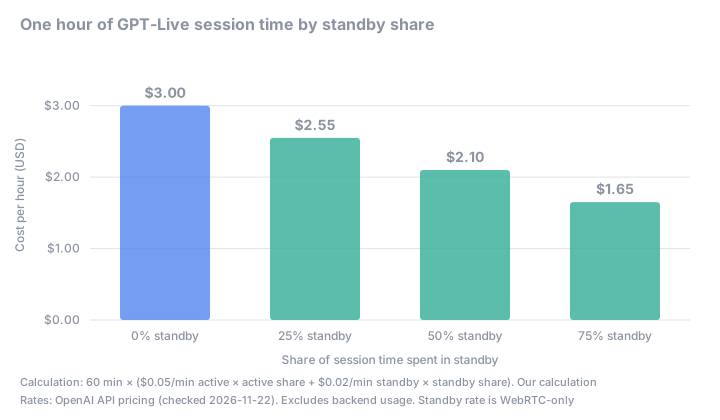
At a 50% standby share the hourly cost drops from $3.00 to $2.10, a 30% cut. The standby share is not the same as the silence share. A session enters standby only after idle_timeout_s has passed, so the longer the timeout, the smaller the standby share relative to the silence. A shorter timeout means entering standby more often, and the docs note that after standby the first response to a short utterance may take longer.
The scope is also narrow. The 1.1 model page says the standby rate applies to WebRTC sessions while inference is paused, and the configuration guide is written for WebRTC sessions. Phone lines connected over SIP and WebSocket connections are not described as covered. Phone support is usually where silence runs longest, so the use case with the most to gain is the one left out.
Why there are no performance numbers
There are no benchmark numbers for GPT-Live-1.1 yet. OpenAI described the direction of the improvements in the model page and changelog but published no scores, and the performance and speed fields on the 1.1 page read "Not specified."
Third-party results exist only for version 1. As of November 22, 2026, the Artificial Analysis Speech to Speech leaderboard lists GPT-Live-1 in two configurations: 83.2 with an Astra (medium) backend and 80.1 with a Sol (low) backend. There is no 1.1 entry. These scores include the backend model, so the same GPT-Live-1 scores differently depending on what it delegates to. When 1.1 appears, the backend configuration has to match before the two can be compared.
The non-English claims are in the same position. When 1.1 rolled out in ChatGPT on October 15, an announcement post on the developer forum said performance had improved "considerably" in French, German, Hindi, Mexican Spanish, Korean, Japanese, and other non-English languages. No per-language error rates were published.
GPT-Live and the Korea region
OpenAI offers data residency, which keeps customer data stored in a given region, through regional domains. Korea's is kr.api.openai.com. Here is the Korea row of the data residency docs next to the US row.
| Item | United States (us.api.openai.com) | Korea (kr.api.openai.com) |
|---|---|---|
| Regional storage | Yes | Yes |
| Regional processing | Yes | No |
v1/live/sessions (GPT-Live) | Listed | Not listed |
v1/realtime (Realtime API) | Listed | Not listed |
The GPT-Live entry is explicit: "GPT-Live supports data residency in the United States and Europe." A project that must keep OpenAI API data stored in Korea cannot use GPT-Live today, whether 1 or 1.1. The US and EU side needs a check too: the GPT-Live row of the same docs lists only gpt-live-1 under supported models, and as of November 22, 2026, 1.1 is not in that column. The Realtime API is missing from the Korea row as well, so OpenAI has no real-time speech-to-speech option under that condition. Transcription (v1/audio/transcriptions) and speech generation (v1/audio/speech) are listed, so a chained pipeline of transcription, response generation, and speech synthesis can stay within Korea storage.
There are storage choices inside GPT-Live too. Session storage is off by default. With store: true, the completed session recording is kept for 30 days. Under Zero Data Retention, store is always treated as false. The docs say there is no public endpoint to delete a stored session, so for calls that carry personal data, check whether 30-day retention is acceptable before turning storage on.
Reactions on the developer forum
We found no dedicated Hacker News or Reddit threads about the API release. Most of the discussion is on OpenAI's developer forum, and much of it is about voice changes in ChatGPT after the October rollout.
People who welcomed the accent work pointed at a problem in version 1. Forum user merefield wrote: "The current models seem to bleed one accent into another, this is great news" (forum thread).
Criticism centered on ChatGPT's voices. User Griss said the Sol voice now "sounds like a scripted robot," and on November 21 user CaioCalistro posted about the forced move to GPT-Live, citing "an excess of artificial interjections" and "frequent loss of context" (forum thread). From the API side, user borau wrote that "Turkish voices via the API are terrible" and asked whether 1.1 would help. Under the API announcement, user _j pointed out that the GPT-Live-1 docs had per-tier limits while the 1.1 page does not (forum thread).
What this changes for teams building in Korea
If you already run a service on GPT-Live-1, turning on standby looks like the surer win than switching to 1.1. Standby works on 1 and its rate is fixed in the docs, while 1.1's quality gains have no numbers yet. Since 1.1 has its own concurrency limit, the sensible test is to move a share of sessions and compare against your own Korean call recordings. Note that the only built-in Korean voice is Noeul (feminine); if you need another, you will have to test a custom voice created from a text description.
If you are building a new voice support product, check data storage requirements first. Teams in finance, healthcare, or the public sector that are contractually bound to store data in Korea appear unable to adopt GPT-Live for now. If your main channel is the phone, standby pricing does not apply either, so this update does not change your cost structure. The clearest beneficiaries are web and app voice assistants with long idle stretches.
We covered OpenAI's decision-only endpoint, which GPT-Live can call natively, in our Gemini Decisions API comparison, and the newest backend models in our GPT-6.2 Astra and Sol post.
Limitations
| Item | Detail |
|---|---|
| No hands-on test | We did not call GPT-Live-1.1 or measure Korean quality or latency. The comparison table is built from official docs only |
| Performance | Neither vendor nor third-party numbers exist for 1.1. The Artificial Analysis scores are for GPT-Live-1 and depend on the backend |
| Cost math | Figure 1 counts session-time charges only. It excludes backend model and tool usage, connection setup charges, and the timeout before standby begins |
| Regions | The data residency table reflects the docs as checked on November 22, 2026. The lists can change |
| Forum quotes | These are individual users' views, and many concern ChatGPT voice rather than the API |