
News · · 8 min read
MAI Code 2: What the '98% average' hides, benchmark by benchmark, and the cost after the discount
In this post
Microsoft AI announced its in-house coding models MAI Code 2 and MAI Code 2 Flash at Ignite on November 17, 2026, and both shipped in GitHub Copilot the same day. Microsoft's headline is that, averaged over four benchmarks, MAI Code 2 delivers 98% of GPT-6.1 Sol's performance at 40% of the cost. The chart data embedded in the announcement tells a less uniform story. MAI Code 2 beats GPT-6.1 Sol on FrontierCode v1.1, but trails Claude Opus 5.5 by 14.4 points on SWE Atlas. The cost figures also use a 50% promotional price that runs until May 17, 2027. At list price, our own calculation puts MAI Code 2 at about 81% of GPT-6.1 Sol's cost per task.
This post covers where you can use MAI Code 2, the four benchmarks shown separately, who ran each measurement, the Flash model and post-promotion costs, and the Hacker News reaction. It ends with what teams already on GitHub Copilot should check.
Where it is available
For now, GitHub Copilot is effectively the only way to use MAI Code 2. GitHub's changelog lists plan availability as follows.
| Model | Copilot plans | Other routes |
|---|---|---|
| MAI Code 2 | Pro, Pro+, Max, Business, Enterprise | None |
| MAI Code 2 Flash | Free, Student, Pro, Pro+, Max, Business, Enterprise | Limited-access preview in Microsoft Foundry |
Table 1. Compiled from the GitHub changelog (2026-11-17) and the Microsoft AI announcement
The changelog adds that both models are available to eligible Copilot subscribers on annual plans. Inside Copilot, both models appear in the model picker in VS Code, Visual Studio, JetBrains, Xcode, Eclipse, Copilot CLI, the Copilot cloud agent, the Copilot app, github.com, and GitHub Mobile. Microsoft says the models will come "soon" to OpenRouter, Vercel, Hermes, OpenCode, and Kilo, without a date. The only API route mentioned in the announcement and changelog is the Flash preview in Foundry; we found no public way to call MAI Code 2 from your own service.
One line in the changelog matters for admins. On Business and Enterprise, new models are enabled automatically under default model enablement unless an administrator has turned off the global default or disabled the model. If nobody changed that setting, your developers can already pick MAI Code 2.
Four benchmarks under the 98% average
The charts in Microsoft's announcement carry per-benchmark pass rates and cost per task as data. We redrew those values as Figure 1. All three models ran at max reasoning effort.
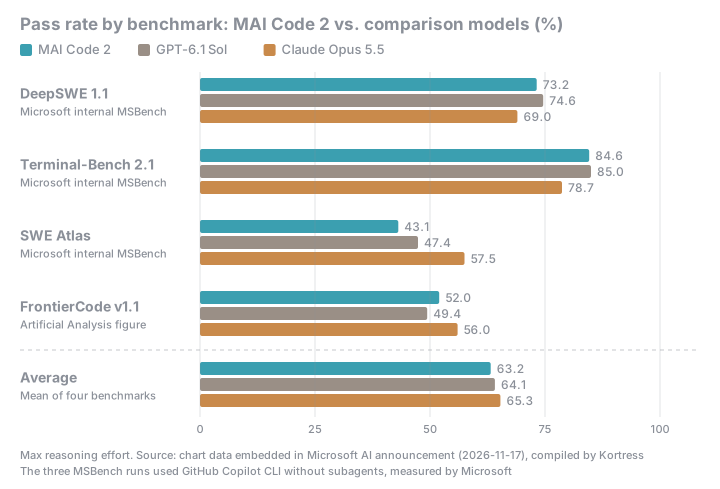
The averages sit within 2.1 points of each other: 63.2%, 64.1%, and 65.3%. Split by benchmark, the order changes every time. On DeepSWE 1.1 and Terminal-Bench 2.1, MAI Code 2 is within 1.4 points of GPT-6.1 Sol and ahead of Opus 5.5. On FrontierCode v1.1 it scores 52.0%, above GPT-6.1 Sol's 49.4%.
The wide gap is on SWE Atlas. MAI Code 2 scores 43.1%, which is 4.3 points below GPT-6.1 Sol (47.4%) and 14.4 points below Opus 5.5 (57.5%). That is roughly 75% of Opus 5.5's score. The "96% of Opus" average exists because leads on DeepSWE and Terminal-Bench offset the SWE Atlas gap. Microsoft itself says the models are "explicitly not yet tuned" for harder problems such as fundamental science research and very long-horizon agentic work. Which benchmark resembles your own work varies by team, so it seems more useful to judge by the one or two closest to your tasks than by the average.
Cost is simpler. Mean cost per task across the four benchmarks is $0.309 for MAI Code 2, $0.761 for GPT-6.1 Sol, and $6.306 for Opus 5.5. MAI Code 2 was the cheapest on every one of the four. Quality varies by benchmark; the cost ranking does not.
Who measured these numbers
Three of the four benchmarks (DeepSWE 1.1, Terminal-Bench 2.1, SWE Atlas) were run on MSBench, Microsoft's internal evaluation platform, using the GitHub Copilot CLI without subagents. The announcement's footnote says all models ran at max reasoning effort. Only the FrontierCode v1.1 scores and costs come from Artificial Analysis, according to Microsoft.
As of November 20 we found no independent third-party measurement of MAI Code 2. Artificial Analysis returned a 404 for a MAI Code 2 model page (/models/mai-code-2). The nine values from the three MSBench benchmarks in Figure 1 should therefore be read as vendor-reported. Microsoft AI has openly worked on improving MAI models in Copilot, to the point of publishing "Hill-climbing MAI models for GitHub Copilot and Excel" in July. The Copilot CLI harness may well favor MAI models, and it is hard to assume the same gaps would hold in other agent tools.
The comparison generation matters too. OpenAI released GPT-6.2 Sol the same day (we covered it in the GPT-6.2 Astra and Sol post). Microsoft compared against the previous model, GPT-6.1 Sol, and published no same-harness numbers for GPT-6.2 Sol.
Flash, and cost per task after the promotion
GitHub's pricing docs list both models at promotional pricing until May 17, 2027. The promotional rates are exactly half the list rates, which Microsoft's footnotes call the "50% promotional price." Prices are per million tokens.
| Model | Promo (input / cached input / output) | List price from 2027-05-17 |
|---|---|---|
| MAI Code 2 | $0.50 / $0.025 / $2.50 | $1.00 / $0.05 / $5.00 |
| MAI Code 2 Flash | $0.05 / $0.005 / $0.25 | $0.10 / $0.01 / $0.50 |
| MAI-Code-1.1-Flash (previous) | $0.20 / $0.02 / $1.20 | Retired 2026-12-18 |
Table 2. Compiled from GitHub Docs, "Models and pricing for GitHub Copilot" and the GitHub changelog (checked 2026-11-20)
The previous MAI-Code-1.1-Flash will be deprecated across all Copilot experiences on December 18, 2026. GitHub asks users to move to the latest MAI Code Flash model before then and notes that Enterprise admins may need to enable the alternative in their model policies. If you use 1.1 Flash today, moving to Code 2 Flash is a deadline, not an option.
Microsoft's footnotes say all its MAI cost figures use the promotional price. Every rate exactly doubles at list price, so if token usage stays the same, cost per task doubles as well. On that basis, MAI Code 2's mean cost per task becomes $0.618: about 81% of GPT-6.1 Sol's $0.761 and about 10% of Opus 5.5's $6.306. "40% of the cost" holds during the promotion, but after next May the gap with GPT-6.1 Sol narrows considerably.
The effect is starker for Flash. Here are the three benchmarks Microsoft used to compare it.
| Benchmark | MAI Code 2 Flash | GPT-6 Luna | Claude Haiku 5.5 |
|---|---|---|---|
| DeepSWE 1.1 | 59.9% | 59.6% | 46.0% |
| Terminal-Bench 2.1 | 78.3% | 69.3% | 73.4% |
| SWE Atlas | 44.8% | 36.4% | 42.1% |
| Mean cost per task | $0.052 | $0.080 | $0.319 |
Table 3. Compiled from chart data in the Microsoft AI announcement. All three benchmarks on MSBench with Copilot CLI at max reasoning effort; Flash cost at promotional price
Flash has the highest pass rate on all three, averaging 61.0% against GPT-6 Luna's 55.1%. At the promotional price it costs 65% of Luna per task. The announcement text says Flash costs 20% of Claude Haiku 5.5; from the chart values, $0.052 ÷ $0.319 is about 16%. At list price, Flash's mean cost per task becomes $0.104, about 30% more than GPT-6 Luna's $0.080. By Microsoft's own numbers, after May 2027 Flash keeps a cost advantage over Haiku 5.5 (about 33% of its cost) but loses it against Luna.
Hacker News reaction
The Hacker News thread for the announcement had 422 points and 171 comments when we checked on November 20. Reactions split between hands-on praise and doubts about how the comparison was framed.
On the positive side, chopete3 switched Copilot to MAI Code 2 right after launch at the 50% price, fixed tricky Python build issues in Windows WSL/Ubuntu and all of its Azure (bicep) deploy problems, and wrote: "Didn't feel the difference from Claude Opus" (comment). skc said it "Seems pretty good for coding", adding that for the average use case there is no meaningful difference from the state of the art (comment).
On the critical side, oofbaroomf noted that Microsoft compared against GPT-6.1 Sol's API prices and that against GPT-6.2 Sol, especially counting the subsidy from Codex subscriptions, "it's probably no longer on the Pareto frontier" (comment). tomatoandbasil pointed to the promotion running until May 2027 and asked, "Why not just make the price lower," given the models may be irrelevant by the time the real price kicks in (comment). programmancer tried it twice at work and both times it spun for 20+ minutes on basic prompts showing only "Preparing..." and "Evaluating..." without producing output (comment). jwpapi asked whether it is available through an API at all (comment).
What Copilot teams should check
First, Business and Enterprise admins should review the model policy. With default enablement on, MAI Code 2 is already selectable. If your company governs which model providers receive its code, check whether automatic enablement of new models fits that policy.
Second, for teams on usage-based Copilot billing, MAI Code 2 looks worth trialing as a default during the promotion, since its cost per task is about 40% of GPT-6.1 Sol and about 5% of Opus 5.5. Build the trial set deliberately, though, and include task types like SWE Atlas where MAI Code 2 trailed badly. If results diverge on large multi-file changes, it seems sensible to keep big jobs on your current top model and move only routine work.
Third, Flash on the Free and Student plans is a change that reaches individual developers and students directly. If you make Flash a team default for cost reasons, mark May 17, 2027 on the calendar: by Microsoft's own numbers, Flash becomes more expensive per task than GPT-6 Luna after that date.
For teams that want to wire a coding model into their own product via API, nothing changes yet. We found no public API route for MAI Code 2, and Flash is in a limited-access Foundry preview.
Limitations
| Item | Detail |
|---|---|
| Who measured | Three of four benchmarks were measured by Microsoft on internal MSBench. No independent re-measurement found at time of writing |
| Harness | All values use GitHub Copilot CLI without subagents at max reasoning effort. Other tools or effort levels may differ |
| Comparison target | GPT-6.1 Sol. No same-condition comparison with GPT-6.2 Sol, released the same day |
| List-price cost | Our calculation assumes token usage is unchanged. Real token usage depends on prompts and repositories |
| Our own testing | This post compiles and calculates from published figures. Kortress did not run MAI Code 2 itself |
What generalizes is the direction (an average can hide large per-benchmark gaps), not the specific numbers. When third-party measurements such as Artificial Analysis appear, the three MSBench values in Figure 1 are the first to recheck.
Sources
- Microsoft AI, "MAI Code 2 and Code 2 Flash: Everyday coding at scalable prices" (2026-11-17): https://microsoft.ai/news/introducing-mai-code-2-and-mai-code-2-flash/
- GitHub Changelog, "MAI Code 2 and MAI Code 2 Flash in GitHub Copilot" (2026-11-17): https://github.blog/changelog/2026-11-17-mai-code-2-and-mai-code-2-flash-in-github-copilot/
- GitHub Docs, "Models and pricing for GitHub Copilot": https://docs.github.com/en/copilot/reference/copilot-billing/models-and-pricing
- Hacker News discussion: https://news.ycombinator.com/item?id=50535885