
News · · 7 min read
Gemini 4 Neon: where it lands between Hydrogen and Carbon in third-party tests
In this post
Google released Gemini 4 Neon (gemini-4-neon) on November 18, 2026, and opened it the same day on the paid tier of the Gemini API and to Pro and Ultra subscribers in the Gemini app. Google's docs place Neon between Hydrogen, the everyday model, and Carbon, the model for the hardest problems. In Artificial Analysis's independent testing, Neon at its default high thinking level scored 60 on the Intelligence Index, the same as Carbon at high, while taking roughly 2.5 times less time per task. Carbon is still discounted through November 30, though, so the reason to switch this month is speed, not cost.
This post covers what Neon is and who can use it, a chart we compiled from Artificial Analysis data for all three Gemini 4 models, where Google's claims and the third-party numbers disagree, and the Hacker News reaction. It ends with what developers already on Carbon or Hydrogen might want to try.
Where Neon fits
The Gemini 4 models available through the API are now Carbon, Neon, Hydrogen and Argon. Google's Neon guide splits the work this way. Carbon handles the hardest architecture, debugging, science and security problems. Hydrogen stays the default for everyday coding and agent work. Neon covers "high-frequency complex tasks" in between. The request format matches the other Gemini 4 models: a single 1,048,576-token window shared by input, thinking and output, long decode up to 1M tokens, and four thinking levels (low, medium, high as the default, and xhigh).
Neon costs $3 per million input tokens and $15 per million output tokens, with thinking tokens billed as output. That is twice Hydrogen's $1.50 / $7.50 and 25% below Carbon's list price of $4 / $20, which takes effect December 1. Until November 30, Carbon sells at half that, $2 / $10. So for the rest of this month, Neon's per-token price is 1.5 times Carbon's.
Here is where Neon is available:
| Surface | Who | Notes |
|---|---|---|
| Gemini API, Google AI Studio | Paid-tier developers; AI Pro and Ultra subscribers (AI Studio) | Not on the free tier |
| Gemini app | Google AI Pro and Ultra subscribers | Pick it from the model menu |
| Google Antigravity | Paid AI Pro and Ultra subscribers, enterprises | Can also orchestrate Hydrogen subagents |
| Gemini for business | Enterprises | API and model menu |
Table 1. Compiled from Google's announcement and the Gemini API pricing and changelog pages
The security variant, Gemini 4 Neon for cyber, is not generally available. Google says it will reach members of its Fairwind Program over the next few days. Unlike Hydrogen, Neon has no free tier, which is the first hurdle for individual developers.
Eleven configurations on one chart
Artificial Analysis tests each of Neon's four thinking levels separately. We took those values plus Hydrogen's four levels and Carbon's three from the same site and plotted them in Figure 1. The score is the Artificial Analysis Intelligence Index (v5.0.1), which combines nine evaluations. The horizontal axis is the average cost to run one task from that index.
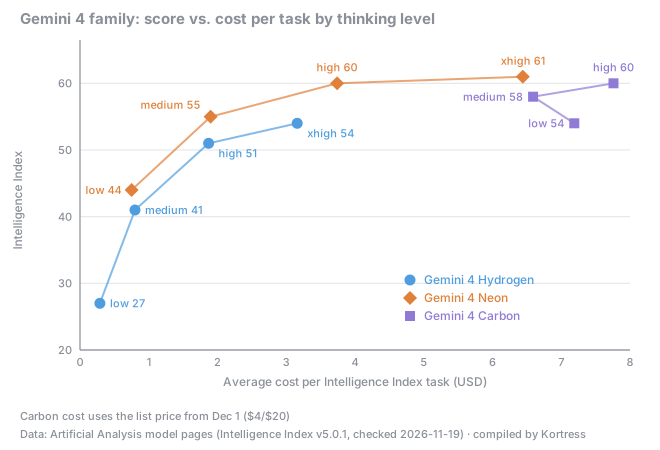
The values behind the chart, with time per task:
| Configuration | Index | Time per task | Cost per task |
|---|---|---|---|
Hydrogen high | 51 | 8.6 min | $1.87 |
Hydrogen xhigh | 54 | 15.3 min | $3.16 |
Neon low | 44 | 3.7 min | $0.75 |
Neon medium | 55 | 8.3 min | $1.90 |
Neon high (default) | 60 | 14.8 min | $3.74 |
Neon xhigh | 61 | 21.5 min | $6.44 |
Carbon medium | 58 | 29.6 min | $6.59 |
Carbon high | 60 | 37.1 min | $7.76 |
Table 2. Compiled from three Artificial Analysis model pages (checked 2026-11-19). Hydrogen low and medium and Carbon low appear only in Figure 1. Carbon costs use the $4 / $20 prices Artificial Analysis applies
Neon high and Carbon high both score 60. Carbon takes 37.1 minutes per task to Neon's 14.8, about 2.5 times as long. Neon's cost per task is $3.74 against $7.76, about 52% lower. Comparing the headline configurations on each Artificial Analysis model page, Neon xhigh reached its first answer token in 56.51 seconds against 73.19 seconds for Carbon high, and generated 110 tokens per second against 55. Those two figures compare different thinking levels.
The cost comparison comes with a condition. The $7.76 for Carbon uses the list price that starts December 1. Every Carbon rate, input, cache and output, is exactly half that through November 30. By our calculation, Carbon high costs about $3.88 per task this month, only about 4% more than Neon high at $3.74. Switching to Neon in November buys you time, not savings.
Lower down, Neon medium stands out. It takes almost the same time (8.3 vs. 8.6 minutes) and money ($1.90 vs. $1.87) as Hydrogen high and scores four points higher. It even beats Hydrogen xhigh by a point while using less time and money. At the other end, Neon xhigh adds one point over high at about 1.45 times the time and 1.72 times the cost. Google's docs likewise say to reserve xhigh for hard multi-step problems where high falls short.
Where Google's claims and third-party numbers disagree
Google's announcement says that at its default high level, Neon pairs a high Artificial Analysis Intelligence Index score with a cost per task 32% lower than Carbon's. It does not say how the cost was measured. Using the current Artificial Analysis values, the gap is about 52%. Using Carbon's discounted November price, it is about 4%, and pitting Neon xhigh ($6.44) against Carbon high gives about 17%. None of these matches 32%. The announcement gives no date or price basis for its figure. A different measurement date or index version seems the likely explanation.
Many of the other numbers Google cites come from outside leaderboards: 58.6 on the Artificial Analysis Coding Agent Index (first), 70.9% on the Vals Index (second) and 1336 on the Agent Arena Index (second). By contrast, the 39.0% on SWE-sweep was measured in Google's own Antigravity harness, and figures such as the 2.45% coding-shortcut rate and the "lowest fabrication rate yet" come from Google's internal evaluations. Google also notes that the same model scored 12.8% on SWE-sweep with the mini-SWE harness. That is more than a threefold jump inside Google's own tooling, so don't expect the same margin from a different agent setup.
One independent real-world test pointed the other way. Hacker News user chriddyp posted results from their own 43-question data-analytics benchmark. All four Gemini 4 models earned an A, and costs ran "Hydrogen ($6) < Carbon ($11) < Argon ($13) < Neon ($17)." In that test, Neon was the most expensive, though the poster noted that their harness does a fair bit of prompting to guide the model. Cost per task depends on how many tokens a model spends, not just on its price list, so Table 2 doesn't guarantee that Neon will be cheaper on your workload.
Hacker News reaction
By November 19, the Hacker News thread for Google's announcement had more than 640 comments. Reactions split between praise for the speed and frustration with the lineup.
On the positive side, people noticed the speed. seizethecheese reported Neon running at 127 tokens per second on OpenRouter: "This is way faster than Carbon at 46 tokens per second." MisterBiggs wrote, "the model seems pretty smart but its super eager and runs down tasks really well and efficiently."
Critics pointed to overlapping tiers. low_tech_punk wrote, "Carbon and Argon already have overlaps, and they are adding Neon to the mix, with almost the same price and marginal improvement." declanjackson, who disclosed working at Artificial Analysis, pointed out that while Neon scores higher overall, it trails Carbon on evaluations like CritPt that test research-scale reasoning. Their reading is that Carbon remains the long-horizon model.
What changes for developers
If you already call Carbon through the API, it's worth running the same jobs on Neon high. Third-party testing gives the two the same overall score, and Neon took about 40% as long per task. That looks like a real gain where waiting is the cost, such as coding agents a person is watching. Since some research-level evaluations still favor Carbon, as the HN comment noted, compare by task type rather than moving everything at once. The cost advantage only appears once Carbon's list price applies on December 1. Through November, decide on speed.
If Hydrogen at high or xhigh hasn't been good enough, Neon medium is the first thing to try. In Artificial Analysis testing, it scored four points higher than Hydrogen high at nearly the same time and cost. Developers on Hydrogen's free tier will need a paid tier to use Neon. Our earlier posts on Hydrogen's thinking levels and Carbon vs. Argon still hold. Neon adds one more option between them.
Limitations
| Item | Detail |
|---|---|
| No direct testing | We did not call Neon ourselves. All scores, times and costs come from Artificial Analysis |
| Timing | Values checked 2026-11-19, one day after launch. They may change |
| Workload scope | The Intelligence Index bundles nine evaluations. As the HN user's benchmark shows, cost rankings can flip on your own tasks |
| Discounted-price estimate | Carbon's November cost of $3.88 is our own calculation (Artificial Analysis's value halved, following the price ratio), not an Artificial Analysis measurement |
| Community quotes | HN reactions are first impressions from launch day, based on individual use |
Sources
- Google, Introducing Gemini 4 Neon (2026-11-18): https://blog.google/innovation-and-ai/models-and-research/gemini-models/introducing-gemini-4-neon/
- Google AI for Developers, What's new in Gemini 4 Neon: https://ai.google.dev/gemini-api/docs/whats-new-gemini-4-neon
- Google AI for Developers, Gemini API pricing: https://ai.google.dev/gemini-api/docs/pricing
- Google AI for Developers, Gemini API changelog: https://ai.google.dev/gemini-api/docs/changelog
- Artificial Analysis, Gemini 4 Neon · Gemini 4 Carbon · Gemini 4 Hydrogen
- Hacker News, Gemini 4 Neon discussion: https://news.ycombinator.com/item?id=50552424