
News · · 9 min read
Genie 4 Reaches Project Genie and the Gemini API: The Missing Numbers and a 120-Second Session Cap
In this post
Google opened its Genie 4 world model to Google AI Ultra subscribers in Project Genie on November 18, 2026, and to paid-tier developers on the Gemini API and Google AI Studio on November 19. The API documentation also fills in the numbers that were missing from the October 27 announcement. Output is 1280x720 (720p) at 24 frames per second, and a session lasts at most 120 seconds. The documentation describes a shorter window in which the picture is most stable. Billing is by video output tokens and works out to about $0.10 per second. Genie 4 is served from the United States, Western Europe, and Japan.
This post covers how the October gaps were filled, the time limits of a single session, what the API can and cannot do, how billing works, what changed in Project Genie, and what Hacker News commenters said.
October's gaps, filled by November's docs
In our October 29 post on Genie 4, we noted that DeepMind gave no numbers for resolution, frame rate, or duration. We took those same rows and filled them in from the new Gemini API documentation (guide, model page, pricing, rate limits) and Google's blog posts.
| Item | October 27 announcement | November 18–19 docs |
|---|---|---|
| Resolution and frame rate | Not published | 1280x720 (720p), 16:9, 24 fps |
| Session length | Coherent over "short sessions," no number | Up to 120 seconds per session |
| Audio | Ambient sound, music, and dialogue | 48 kHz stereo, bundled into video tokens |
| API audience | Early access partners, "coming soon" | Paid tier of the Gemini API (no free tier) |
| Project Genie | "Coming soon" to Ultra, waitlist | Rolling out to Ultra; Pro subscribers can join a waitlist |
| Serving regions | Not mentioned | United States, Western Europe, Japan |
Session length is the number we left unconfirmed in October. At the time, TechCrunch reported that Genie 4 "can maintain a consistent scene for up to two minutes," but no DeepMind document said so, so we did not treat it as a spec. The new model page now puts the session cap at 120 seconds, the first time that figure has appeared in an official document. The cap is when a session ends, though, not a promise that the picture holds up for all 120 seconds.
The time limits of one session
The documentation scatters its timing figures across several pages. Put on one axis, they show what a Genie 4 session is actually good for. Figure 1 compiles the numbers from the Genie 4 guide and the model page.
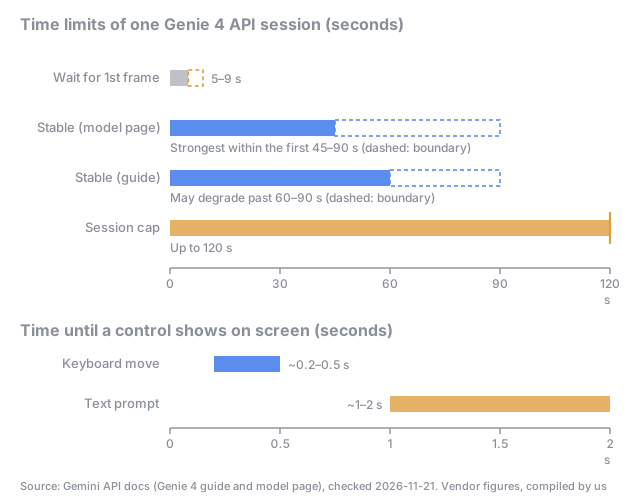
After you create a session, the first frame takes about 5–9 seconds to arrive. From then on, WASD movement and arrow-key camera turns show up on screen within about 0.2–0.5 seconds when network round-trip latency is low. A text prompt such as "make heavy snow fall" takes about 1–2 seconds. The documentation says this is because Genie 4 plans environmental changes between generation steps. Keys act immediately. Text waits for the next planning window.
The two documents disagree on the stable window. The model page says visual coherence and object permanence are "strongest during the first 45–90 seconds." The limitations section of the guide says "visual stability may degrade past 60–90 seconds." Either way, quality starts to slip before the 120-second cap, so Figure 1 shows both figures separately.
Object permanence now has numbers too. The guide explains that Genie 4 does not keep a 3D scene. It simulates frames over a rolling time window instead. Look away from an object for 8 seconds or more, or turn 360 degrees, and landmarks, doors, or buttons can move or reset. In October we quoted a Hacker News commenter who noticed that objects changed after leaving the frame and coming back. Google's documentation now acknowledges the same behavior, with conditions attached.
What the API can and cannot do
You call Genie 4 as the model genie-4 on the Interactions API (v1beta). Browsers connect over WebRTC (the recommended option) or WebSocket, and Python or Node.js servers connect over WebSocket. The guide tells developers to mint a per-session token (auth_tokens/...) on the server and pass it to the browser, rather than putting a long-lived API key in client code.
There are only three kinds of input: a text prompt at setup, a single 16:9 reference image, and keyboard and camera events. The following are not supported:
- Live microphone or webcam input
- Function calling, Google Search grounding, structured outputs
- Resuming a completed session
- Portrait (9:16) output or a different frame rate
- Batch API, Flex inference, Priority inference
Content filters are a further limit. Prompts or images that contain identifiable real people, public figures, or copyrighted brand IP can be blocked at startup or end a stream mid-session. Any project that recreates real places or people should check this first.
Rate limits are set by concurrent sessions and daily requests. Movement and text events inside a session do not count against a separate quota.
| Usage tier | Concurrent active sessions | Requests per day |
|---|---|---|
| Free | Not supported | Not supported |
| Tier 1 | 2 | 50 |
| Tier 2 | 5 | 250 |
| Tier 3 | 10 | 1,000 |
At Tier 1 you can run two worlds at once. That is too few for a public service with many simultaneous users, and seems sized for prototypes and internal demos.
Billing, and sessions that never end
Genie 4 bills by video output tokens. Each frame is 240 tokens, so one second is 5,760 tokens, priced at $17.50 per million. The pricing page converts this to about $0.10 per second, or about $6.05 per minute. Audio is included in the video token rate. Input is $1.50 per million tokens for text or a reference image.
A session that runs to the 120-second cap produces 691,200 output tokens, or about $12.10 (120 seconds × 5,760 tokens × $17.50 per million, our calculation). That figure leaves out input tokens.
The bigger cost risk is how sessions end. The guide says that closing a browser tab or detaching the connection (detach) does not stop generation on the server right away. Only complete() or cancel() stops generation and billing. Sessions cannot be resumed either, so you cannot pause one by disconnecting and reconnecting. A service would likely need server-side logic to end a session when a user simply closes the tab.
What changed in Project Genie
Starting November 18, Genie 4 is rolling out to Ultra subscribers in Project Genie. According to Google's blog, users can type prompts mid-session to change the weather or add characters, with audio that adapts to the scene. Google also added a Project Genie agent that builds worlds through conversation, and a gallery for exploring and remixing other people's worlds.
Genie 3 was updated as well. Each generation can now run for up to 3 minutes instead of 60 seconds, and worlds can start from a 360-degree panorama image. Google suggests picking Genie 3 in the model selector when you want longer runs or panorama-seeded spaces. The split is Genie 3 for length, Genie 4 for fidelity and sound.
Per the Labs help page, Project Genie is open to Ultra subscribers aged 18 and over wherever Google AI Ultra is offered. Google AI Pro subscribers can join a waitlist. South Korea is on the Gemini Apps help page's list of countries where Google AI Pro and Ultra are offered, so Ultra subscribers in Korea appear to be eligible. Because Project Genie is still an early access research prototype, the help page says creating worlds does not use AI credits, but daily limits apply. It says only that exploration time "depends on the model and experience," so it does not state how long a Genie 4 session lasts in Project Genie.
Hacker News reactions
The Project Genie launch post drew 292 points and 184 comments on Hacker News (as of November 21). The API post from November 19 has no comments yet. The quotes below are the commenters' views, not ours.
User int0x29 doubted the demo's object permanence:
"That demo video on the page seems to studiously avoid panning the camera away from something and then back to it without completely altering the scene first. It makes me suspect strong problems with object permanence." — https://news.ycombinator.com/item?id=50554157
Some commenters asked what the model is for. User m12k wrote:
"Does anyone have an example of a real world application for a world model like this? Maybe I'm too narrow-minded, but I'm really struggling to come up with a use case for "lucid dreaming as a service" other than as a cool tech demo." — https://news.ycombinator.com/item?id=50552984
User shipitx offered one:
"Genuinely excited about Genie though. Using it to visualize an animal's umwelt is a lovely idea — I'd pay just to see what a bat's echolocation 'looks' like." — https://news.ycombinator.com/item?id=50554916
Some wanted developer tooling. User yodon asked for 3D export:
"Would love to be able to export an FBX or USD (or even OBJ or Gaussian splats or something) from this" — https://news.ycombinator.com/item?id=50552681
The API documentation answers that request indirectly. Genie 4 does not keep a 3D mesh, so all the API returns today is a stream of video frames and audio (JPEG frames and PCM audio over WebSocket).
What this means for developers in Korea
The main change is that teams now have something to plan around. In October, only early access partners could use the API, and there were no specs. Now anyone with a paid Gemini API key can try it in AI Studio. South Korea is on the Gemini API's list of available regions. Japan is one of the serving regions, and the documentation lists East Asia among the areas with under 150 ms round-trip latency. On a good connection, key response from Korea will likely land near the documented figures. We did not measure it, though, so latency-sensitive projects should follow the documentation's advice and test WebRTC latency from their target region first.
The realistic use is short experiences and prototypes. A 120-second cap, quality that slips after 45–90 seconds, and objects that change once you look away for 8 seconds make Genie 4 a poor game-engine replacement. It looks better suited to short interactive content, mood studies for spatial design, and short scenes for training robots or agents. The Tier 1 limit of two concurrent sessions points the same way.
On cost, ending sessions properly comes first. About $0.10 per second sounds small, but because closing a tab does not stop billing, one session left running can reach the 120-second cap. For a public service, it seems safest to track session time on the server and call complete() from day one.
Limitations
| Item | Details |
|---|---|
| Performance figures | Resolution, latency, and stable-window figures are all from Google's own docs. We found no third-party measurements or benchmarks |
| Hands-on use | This post compares documents. We did not call the Genie 4 API or measure latency from Korea |
| Latency in Korea | "Under 150 ms in East Asia" is the documentation's expectation. Whether Korea falls within it is our inference |
| Project Genie in Korea | Inferred from the Ultra country list and the "where Google AI Ultra is available" wording. Google has not published a separate country list for Genie 4 |
| Language | The docs do not say whether dialogue and text prompts support Korean |
| Conflicting docs | The stable window is 45–90 seconds on the model page and 60–90 seconds in the guide. We could not confirm which is right |
| Timing | As of November 21, 2026. The Interactions API is v1beta, so request formats and limits may change |
Sources
- Google blog, Genie 4 is now available on the Gemini API (2026-11-19): https://blog.google/innovation-and-ai/technology/developers-tools/genie-4-in-gemini-api/
- Google blog, Genie 4 is now available (2026-11-18): https://blog.google/innovation-and-ai/models-and-research/google-deepmind/genie-4-now-available-project-genie/
- Gemini API docs, Interactive world generation with Genie 4: https://aistudio.google.com/docs/genie
- Gemini API docs, Genie 4 model page: https://aistudio.google.com/docs/models/genie-4
- Gemini API docs, Pricing (Genie 4): https://aistudio.google.com/docs/pricing
- Gemini API docs, Rate limits (Genie 4): https://aistudio.google.com/docs/rate-limits
- Gemini API docs, Available regions: https://aistudio.google.com/docs/available-regions
- Google DeepMind, Genie 4: A new generation of world simulation (2026-10-27): https://deepmind.google/blog/genie-4-a-new-generation-of-world-simulation/
- Google Labs Help, Get started with Project Genie: https://support.google.com/labs/answer/16875695?hl=en
- Gemini Apps Help, Gemini Apps limits & feature availability: https://support.google.com/gemini/answer/16275805?hl=en
- Hacker News, Genie 4 is now available: https://news.ycombinator.com/item?id=50550415
- Hacker News, Genie 4 is now available on the Gemini API: https://news.ycombinator.com/item?id=50563146