
News · · 8 min read
Gemini 4 Hydrogen: Its Four Thinking Levels Side by Side in Third-Party Measurements
In this post
Google announced Gemini 4 Hydrogen (gemini-4-hydrogen) on November 12, 2026 (US time) and shipped it the same day to the Gemini API free and paid tiers, the Gemini app, and Google Search. Google positions it as the recommended upgrade from Gemini 3.8 Flash. In Artificial Analysis's independent measurements, Hydrogen at its default high thinking level scores 51 on the Intelligence Index against 31 for 3.8 Flash (high), and the average time per task drops from 14.7 to 7.9 minutes. The new xhigh level, though, spends about 2.8 times as many output tokens as high to gain three more points. For teams moving off 3.8 Flash, the first decision is the thinking level, not the model ID.
This post covers what changed with Hydrogen, a chart we compiled from Artificial Analysis data comparing score and time across the thinking levels, the rows in Google's own benchmark table where Hydrogen loses, who can use it and where, and the reaction on Hacker News.
What Hydrogen changes in the 3.8 Flash slot
Hydrogen is the newest addition to the Gemini 4 family, alongside Argon and Carbon. Google DeepMind's model card says it is adapted from Gemini 4 Carbon. Carbon and Argon are built for slow, deep reasoning; Hydrogen targets frequent, repetitive work such as writing code, running tests, and calling tools.
The change developers will feel first is the thinking level. Hydrogen accepts low, medium, high, and a new xhigh, and it defaults to high. According to Google's migration guide, 3.8 Flash defaulted to medium, and Hydrogen rejects minimal with an error. Code that never set a thinking level will, after swapping only the model ID, call a model that reasons one step deeper.
The same guide lists request-format changes:
- Input, thinking, and output share a single 1,048,576-token window. A synchronous response is capped at 65,536 tokens; longer outputs continue through background execution
- Explicit context caching (
cachedContents) is not supported. Only implicit caching remains, applied by default to prompts of at least 4,096 tokens, with a 95% discount on cached input tokens - The server ignores
temperature,top_p, andtop_kif you send them
These three match the request changes we covered for Gemini 4 Argon. For a service that has only used 3.8 Flash, this is its first encounter with the Gemini 4 request style.
Score and time per task by thinking level
Artificial Analysis benchmarks each of Hydrogen's four thinking levels as a separate entry. We put them in one table together with the 3.8 Flash (high) and Argon (high) entries from the same site. The score is the Artificial Analysis Intelligence Index (v5.0.1), a bundle of nine evaluations; time is the average duration per task in that index.
| Model and level | Index | Time per task | Output tokens for the index |
|---|---|---|---|
Hydrogen low | 27 | 1.3 min | 20.3 million |
Hydrogen medium | 41 | 3.7 min | 54.4 million |
Hydrogen high (default) | 51 | 7.9 min | 110 million |
Hydrogen xhigh | 54 | 13.7 min | 304 million |
3.8 Flash high | 31 | 14.7 min | 126 million |
Argon high | 50 | 30.0 min | 113 million |
Table 1. Compiled by us from six Artificial Analysis model pages (checked 2026-11-13). Output tokens are the total used to run the full index once.
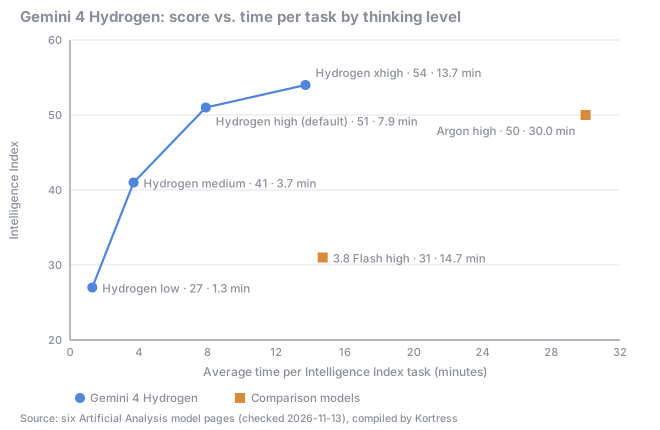
medium already beats 3.8 Flash at high: 41 versus 31, at 3.7 versus 14.7 minutes per task, roughly four times faster. If you ran 3.8 Flash at high, Hydrogen medium is the natural place to start testing.
xhigh is where the curve flattens. Going from high to xhigh adds three points (51 to 54) but multiplies output tokens by about 2.8 (110 million to 304 million), time per task by about 1.7, and time to first answer token by about 2.4 (16.68 to 40.55 seconds). Artificial Analysis ranks xhigh 76th of 77 models on token use. Google's own guide says xhigh can overthink simple prompts and should be reserved for hard multi-step tasks where high falls short.
The same table also covers Argon. Hydrogen high scores 51, essentially level with Argon high at 50, while taking about a quarter of the time per task (7.9 versus 30.0 minutes). Google's "surpasses Argon" line (51 vs. 50) refers to this index, and the margin is one point.
Google says Hydrogen finishes tasks 2.5 times faster than 3.8 Flash. In Artificial Analysis's data, the per-task time ratio of the two at high is 14.7 to 7.9 minutes, about 1.9 times. The figures come from different task sets, so neither is wrong. But since Google has not published the conditions behind its number, starting from 1.9x rather than 2.5x seems the safer expectation for your own workload.
Where Hydrogen loses in Google's own table
Google DeepMind's evaluation methodology document includes a ten-row table comparing Hydrogen, Claude Sonnet 5.5, and GPT-6.1 Terra. Hydrogen tops seven rows and trails Sonnet 5.5 on three.
| Benchmark | Hydrogen | Sonnet 5.5 | GPT-6.1 Terra |
|---|---|---|---|
| Terminal-Bench 4.1 | 57.0% | 63.9% | Not reported |
| OSWorld-2.1 (offline subset) | 77.6% | 83.9% | 74.2% |
| Terminal-Bench-Science 0.1 | 51.4% | 59.9% | 58.3% |
Table 2. Only the rows from Google DeepMind's methodology document where Hydrogen is not first.
The three are agentic coding through chained terminal commands, computer use by reading the screen and driving mouse and keyboard, and terminal-based science tasks. On long shell and screen sessions, Sonnet 5.5, the comparison model in Google's own table, is ahead. If that is your main workload, compare directly before making Hydrogen your default.
The table also mixes sources. Per the same document, most Hydrogen scores come from Google's own harnesses. Competitor scores vary by row: self-reported figures, public leaderboards, system cards, and the Artificial Analysis leaderboard (AutomationBench-AA, HLE-Diamond, MKA). For OSWorld-2.1 in Table 2, Google measured Sonnet 5.5 itself. Read it as a vendor-chosen comparison, distinct from the uniform third-party numbers in Table 1.
The model card carries one more number that is not in the score table. In Google's internal automated safety evaluations, Hydrogen's unjustified-refusal rate (refusing requests that could be answered safely) was 5.57 percentage points higher than 3.8 Flash, and Google notes it is higher particularly for multimodal prompts. Services that accept image input should watch refusal rates after migrating. The knowledge cutoff is March 2026.
Who can use it and where
Here is the rollout scope from Google's announcement and model card, grouped by audience.
| Surface | Who | Conditions |
|---|---|---|
| Gemini API, Google AI Studio | All developers | Free tier included. Paid tier: $1.50 input, $7.50 output per million tokens |
| Gemini app | All users | Free users only when auto model selection picks Hydrogen |
| Google Search | All users worldwide | Applied to Search responses |
| Google Antigravity | Paid Google AI Pro and Ultra subscribers | Includes Orchestrator, which mixes in Carbon |
| Gemini in Google Sheets | Starting with Pro and Ultra subscribers | Plus eligible business subscriptions |
Table 3. Compiled by us from Google's announcement (2026-11-12) and the model card.
Price is a variable you cannot avoid here. Hydrogen's $1.50 / $7.50 equals 3.8 Flash's list price from January 1, 2027. Until December 31, 2026, 3.8 Flash is discounted to half that, $0.75 / $3.75, so on per-token price alone Hydrogen costs twice as much this year. 3.8 Flash remains listed as Stable, with no shutdown date announced.
Community reaction
In the Hacker News thread on the announcement (525 points and 330 comments as of November 13), 19 of the 64 top-level comments brought up the naming scheme (our count). Among comments about performance, opinions were split.
On the positive side, modeless wrote about the charts in the announcement:
"My TL;DR is: seems like a better choice than Sonnet in areas outside of coding, and at high reasoning it's smarter than Terra but somewhat more expensive." — modeless, Hacker News
On the negative side, onlyrealcuzzo pointed to failures benchmarks don't capture:
"They are trading improvements on pass@1 pointless benchmarks for worse disasters at p90/99 that you're going to hit every week in agentic workflows (if not daily): overreach (doing more than asked), overwork (when it should have failed fast)…" — onlyrealcuzzo, Hacker News
ComputerGuru questioned the pricing position: Hydrogen looks like the entry-level model now serving Search, yet it is priced like undiscounted 3.8 Flash, and price-sensitive enterprise customers may leave when the year-end discount ends (Hacker News). These are early personal impressions, not measurements.
What this changes for developers
For services running on 3.8 Flash, three things seem to change.
First, the migration timing is tied to the price schedule. This year 3.8 Flash is half the per-token price; from January 1 the prices are the same. Once they match, the same money buys a model 20 index points higher with shorter time per task, so finishing tests by year-end and switching in January looks like the natural schedule.
Second, the axis to test is the thinking level. Keeping the default high will likely raise output tokens compared with 3.8 Flash at its old medium default. Since medium already beats 3.8 Flash high in Table 1, running your own eval set at medium and high first, and trying xhigh only on tasks where high fails, also matches Google's guidance.
Third, the end-user side is not your choice. Hydrogen now powers Search responses and auto-selection in the Gemini app, so the quality and refusal patterns users see in Search may have shifted this week. Google published no per-language figures, so there is no basis yet to judge quality in languages other than English.
Limitations
| Item | Details |
|---|---|
| Our own measurement | We did not call Hydrogen ourselves. Table 1 reproduces Artificial Analysis figures; Table 2 reproduces Google's |
| Timing | Artificial Analysis values are Intelligence Index v5.0.1, checked on 2026-11-13. The model is brand new and the index itself is being updated, so the numbers may change |
| Task scope | The Intelligence Index bundles nine evaluations. If your prompt length or tool setup differs, the time and token ratios will too |
| Languages | We found no public per-language measurements |
| Safety | The model card's safety numbers are Google's internal automated evaluations; the full Safety & Security Report is not yet published |
For the two earlier Gemini 4 models, see our comparison of Gemini 4 Carbon and Argon on scores and latency.
Sources
- Google, Introducing Gemini 4 Hydrogen (2026-11-12)
- Google AI for Developers, What's new in Gemini 4 Hydrogen
- Google AI for Developers, Gemini API pricing
- Google DeepMind, Gemini 4 Hydrogen model card (PDF)
- Google DeepMind, Gemini 4 Hydrogen evaluation methodology (PDF)
- Artificial Analysis, Hydrogen low · medium · high · xhigh · 3.8 Flash · Argon
- Hacker News, Gemini 4 Hydrogen discussion