
News · · 8 min read
Gemini 4 Carbon Goes Public: Where It Beats Argon at the Same Price, and How Much Longer You Wait
In this post
On November 10, 2026, Google opened Gemini 4 Carbon (gemini-4-carbon) to developers, enterprises and Google AI Ultra subscribers. When it was announced on October 28, only security defenders in the Fairwind program could use it. If you already run Argon, switching is a one-line model ID change at the same per-token price. Two things differ. The score gain over Argon ranges from 0.9 to 12.8 percentage points depending on the benchmark, and third-party measurements show about 30 extra seconds before the first token arrives.
This post covers what Carbon shares with Argon and where it differs, the score gaps we calculated from Google's model card, the latency and token figures measured by Artificial Analysis, the caveat attached to the security scores, and the Hacker News reaction. It ends with a view on which calls are worth moving.
Same request format, same price
Google's developer docs say moving from Argon to Carbon needs no request schema changes. Both models share the 1,048,576-token window used by input, thinking and output together, long decode, and the low, medium and high thinking levels (default medium). Both models share the same price schedule: an introductory $2 per million input tokens and $10 per million output tokens through November 30, then $4 and $20 from December 1. Output pricing includes thinking tokens. If you are coming from Gemini 3.x rather than Argon, the request changes are the ones in our Gemini 4 Argon migration post.
What differs is how many thinking tokens each model spends per turn. The docs say Carbon spends more of them on complex tasks to explore and verify, which raises token use and latency compared with Argon. Google itself recommends keeping Argon for interactive coding, day-to-day feature work and fast production loops. For apps that do move, it gives two practical instructions: raise max_output_tokens to at least 32,768 if it is currently below 32K, and make sure HTTP timeouts allow for longer reasoning. For apps coming from Gemini 3 or earlier, the docs warn that hard prompts can take several minutes and recommend background execution or timeouts of at least 15 minutes.
Here is where Carbon is available.
| Channel | Audience | Condition |
|---|---|---|
| Gemini API, Google AI Studio | Developers | API on paid tier only (no Free tier); Ultra subscribers can also use AI Studio |
| Gemini for business | Enterprises | API, model drop-down, Antigravity, CodeMender |
| Gemini app, AI Mode in Search | Consumers | Google AI Ultra subscribers |
| Google Antigravity | Individual developers | Google AI Ultra subscribers |
Table 1. Compiled by cross-checking Google's announcement and the Gemini API docs (checked 2026-11-12)
South Korea is on the Gemini API's list of available regions, so developers there can call Carbon directly with a paid-tier key.
Where the scores jumped and where they barely moved
Google DeepMind's model card lists Carbon and Argon side by side. Figure 1 takes the 15 benchmarks reported as percentages, subtracts Argon's score from Carbon's, and sorts by the gap. The Artificial Analysis Intelligence Index (points) and Vending-Bench 2 (dollars) are left out because their units differ.
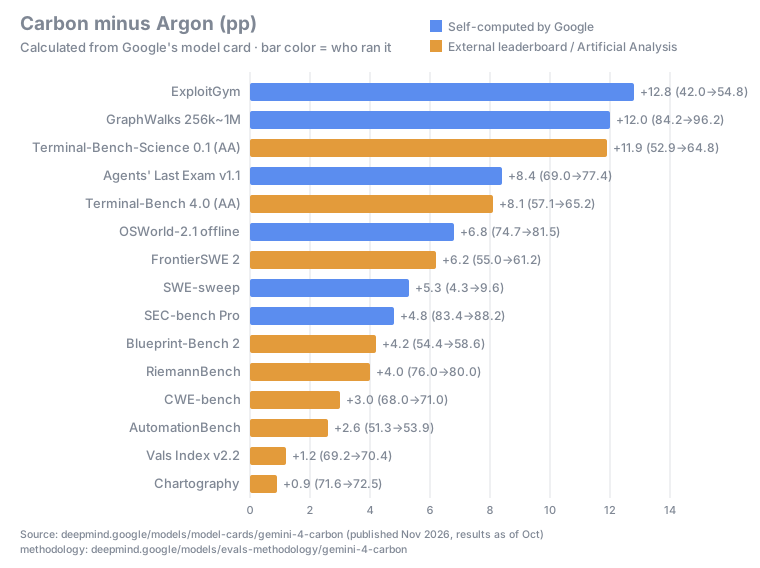
Three benchmarks moved by more than 10 points: ExploitGym, which asks the model to build working exploits (42.0% to 54.8%); GraphWalks, which tracks graph traversal across 256K to 1M tokens of context (84.2% to 96.2%); and Terminal-Bench-Science 0.1, which runs scientific computing tasks in a terminal (52.9% to 64.8%). At the other end, chart reading (Chartography, +0.9), the aggregate Vals Index (+1.2) and Zapier's AutomationBench (+2.6) barely changed. Extra thinking pays off most on long context and multi-step verification, and least on tasks where the answer is settled in one pass.
The bar colors show who ran each benchmark. According to Google's methodology notes, the Carbon scores for ExploitGym, GraphWalks, SEC-bench Pro, OSWorld-2.1, Agents' Last Exam and SWE-sweep were computed by Google, while the rest come from external leaderboards or Artificial Analysis. By our own averaging, the six self-computed benchmarks show a mean gap of 8.4 points and the nine externally sourced ones show 4.7. The two groups also cover different kinds of work, so this alone does not prove the self-reported numbers are inflated. Still, if you trust only the external numbers, Carbon's average advantage is a little over half the self-computed group's.
Latency and tokens, measured by a third party
If benchmark points are the gain, waiting time is the cost. Here are Artificial Analysis's figures for both models at the high thinking level.
| Metric | Carbon (High) | Argon (High) |
|---|---|---|
| Intelligence Index v5.0.1 | 60 | 50 |
| Output tokens per task | 123k | 116k |
| Reasoning tokens per task | 72.2k | 68.3k |
| Output speed | 80 tok/s | 65 tok/s |
| Time to first token | 67.83 s | 37.64 s |
| Mean end-to-end time, single request | 159.39 s | 110.88 s |
| Time per Index task | 25.5 min | 30.0 min |
Table 2. Artificial Analysis's Gemini 4 Carbon vs Argon comparison page (checked 2026-11-12). Measured by Artificial Analysis; speed and latency are 5-day averages and change daily
The token figures point in different directions even on the same page. Output tokens per task are only about 6% higher, but total output tokens to run the whole Index are 205M versus 113M. The latency gap for a single request is clear. By our calculation, time to first token grows by 30.19 seconds, 1.8 times Argon's, and mean end-to-end time per request grows by 48.51 seconds, or about 44%. Carbon actually streams faster once it starts, so most of the extra time appears to sit in the thinking phase before the answer begins.
One number runs the other way. Finishing a multi-step Index task took Carbon 25.5 minutes against Argon's 30.0. Each request waits longer, but over a long agentic task Carbon may wander less and finish sooner.
In its launch analysis, Artificial Analysis also reported that Carbon's accuracy on the AA-Omniscience v1.1 knowledge test rose 10 points over Argon to 58%, while its hallucination rate rose from 4% to 11%. That is still the second-lowest rate on that test after Argon, but for fact-sensitive workloads it is worth checking separately before moving traffic over.
The fine print on the security scores
ExploitGym, the biggest gain in Figure 1, comes with a condition. The model card says its cybersecurity results "reflect performance when accessed through the Fairwind Program", a separate channel that unlocks specialized capabilities for verified defenders. The pricing footnote likewise says it applies to "the Carbon model intended for public access only."
So do not expect the Carbon you reach with a regular API key to reproduce 54.8% on ExploitGym, 88.2% on SEC-bench Pro or 71.0% on CWE-bench. On the same day, Google said it had strengthened Carbon's misuse safeguards. In simulated attack environments seeded with ExploitBench and CyScenarioBench, tested with an adaptive red-teaming agent, the per-attempt breach rate fell from 3.1% on Argon to 0.8%. Those are Google's own figures. Any team planning to use Carbon for security reviews should start from the fact that no public-model scores have been published for these benchmarks.
Mixed first impressions on Hacker News
The Hacker News thread on Google's announcement drew a long discussion on launch day. The optimists talked about quality. User 5555watch, who feeds an unfinished paper draft to different models, wrote: "Carbon's answer surprised me with some interesting points all the other AI's missed. It's an anecdote, sample of one, but it got my attention." The commenter flags it as a single observation.
The skeptics talked about speed and access. eitally, an Ultra subscriber, wrote: "Argon is itself already so slow that I'm not sure Carbon will make sense for most activities." dom96 said Carbon matched another lab's model on their own benchmark but was "still slower and more costly" than it. dieortin pushed back: "How is it more costly? It's 4 times cheaper." alphabettsy replied: "Cheaper on the price list doesn't equal cheaper in use." Much of the thread was about confusion over which subscription tier gets which model. byefruit, checking the Gemini app on a Pro plan, concluded: "Looks like it's Ultra only."
Which calls to move to Carbon
For developers in Korea, the release adds one more model to choose from, and since price and request format are unchanged, switching costs almost nothing. The decision seems to come down to two questions: can the call tolerate the wait, and is it the kind of task where Carbon gains the most?
Calls with a person waiting at the screen look better left on Argon. Chatbot replies, interactive coding in an IDE and short summaries fall here. Artificial Analysis measures close to 68 seconds to first token, and the closest benchmarks in Figure 1, chart reading and workflow automation, barely moved. Background jobs where nobody is waiting are where Carbon is worth testing. Analysis that reads hundreds of thousands of tokens of contracts, logs or code in one go is one example, and GraphWalks, which tests long context, shows the second-largest gap (+12.0 points). Multi-step agent tasks that verify their own work are another.
Timing matters too. Both models double in price on December 1, so November is a good window to run Argon and Carbon side by side on the same inputs and compare quality and the actual bill. Following the docs' advice to try all three thinking levels and pick the lowest that clears your quality bar should also claw back some of Carbon's extra latency.
Limitations
| Item | Detail |
|---|---|
| No first-hand measurement | We did not call Carbon ourselves. Scores come from Google's model card, latency and tokens from Artificial Analysis |
| Timing of figures | The model card reports results as of October 2026. Artificial Analysis pages can change, and versions differ: Index 59 (v5.0) in the launch article versus 60 (v5.0.1) on the comparison page |
| Settings | Model card scores use the highest thinking setting; Table 2 uses high. No figures are published for the default medium |
| Security scores | The three cybersecurity results reflect Fairwind access and may differ from the public API model |
| Community reaction | Individual observations from one thread right after launch; a small sample |
Sources
- Google blog, Gemini 4 Carbon is now available (2026-11-10): https://blog.google/innovation-and-ai/models-and-research/gemini-models/gemini-4-carbon-now-available/
- Google blog, original Gemini 4 Carbon announcement: https://blog.google/innovation-and-ai/models-and-research/gemini-models/introducing-gemini-4-carbon/
- Gemini API docs, What's new in Gemini 4 Carbon: https://ai.google.dev/gemini-api/docs/whats-new-gemini-4-carbon
- Gemini API docs, What's new in Gemini 4 Argon (Argon introductory pricing): https://ai.google.dev/gemini-api/docs/whats-new-gemini-4-argon
- Gemini API docs, available regions: https://ai.google.dev/gemini-api/docs/available-regions
- Google DeepMind, Gemini 4 Carbon model card: https://deepmind.google/models/model-cards/gemini-4-carbon/
- Google DeepMind, Gemini 4 Carbon evaluation methodology: https://deepmind.google/models/evals-methodology/gemini-4-carbon
- Artificial Analysis, Gemini 4 Carbon vs Gemini 4 Argon: https://artificialanalysis.ai/models/comparisons/gemini-4-carbon-vs-gemini-4-argon
- Artificial Analysis, Gemini 4 Carbon launch analysis: https://artificialanalysis.ai/articles/gemini-4-carbon-new-number-1
- Hacker News discussion: https://news.ycombinator.com/item?id=50442303