
News · · 8 min read
Meta Muse Ember: Sorting the Launch Benchmarks by Who Ran Them
In this post
Meta released Muse Ember (muse-ember-1.0) on November 9, 2026. It is the smallest and most efficient model in the Muse family, and Meta pitches it at the work agents repeat all day: tool calls, coding subtasks, routing and extraction. The same day, the independent evaluator Artificial Analysis (AA) reported that Ember scores 36 on its Intelligence Index, level with Claude Haiku 5.5 (max), at $0.14 per index task against Haiku 5.5's $0.41.
Those headline numbers hold up. The rest of Meta's launch table needs more care. When we sorted its ten benchmark rows by who actually ran the test, only half turned out to be third-party results. The others are Meta's own evaluations or scores from different harnesses per model, and three figures disagree with AA's own write-up. This piece is for developers weighing Meta Model API as a subagent tier. It covers what shipped, how far the launch numbers can be trusted, and where the model is weak.
What shipped and where you can use it
Meta's pricing docs group Muse Ember with Muse Wonder and Muse Spark as the per-token reasoning models. The specs below come from Meta's model page.
| Item | Muse Ember (muse-ember-1.0) |
|---|---|
| Input | Text, image, video, audio, PDF |
| Output | Text |
| Context window / max output | 1,048,576 tokens / 524,288 tokens |
| Reasoning effort | "minimal" to "max", default "max" |
| Endpoints | Responses, Chat Completions, Messages |
| Meta channels | Meta Model API pay-as-you-go (Standard mode only), every Muse Code plan |
Source: Meta Model API Muse Ember docs
According to the docs, Ember accepts the same request body as Muse Spark, so switching most code is a model ID change. The docs also spell out the division of labour. Ember is meant for the coding tasks and terminal commands a main agent hands out, for tool calls where cost and latency add up, for routing, and for running one task over thousands of images, files or records. For hard single-shot coding problems, knowledge-heavy questions and visual coding, the docs point you to Muse Spark or Muse Wonder. That last line matches the knowledge results further down.
Meta's research post says Ember is the first model trained using Muse Wonder Full. The weights are not released, and the parameter count is not given anywhere in the launch post or docs. Unlike Meta's Muse Spark Open, which you download and run yourself, Ember is available only as a hosted model. Beyond Meta's own channels, the research post says Muse Ember, Spark and Wonder are available on Google Cloud and Oracle Cloud, and OpenRouter has a Muse Ember model page.
The launch numbers, sorted by who measured them
Meta's evaluation table compares Ember, Claude Haiku 5.5 and GPT-6 Luna, all at max reasoning, across ten rows. The footnotes and chart captions say who measured each row, but the table itself does not show it. We used those footnotes and captions to regroup the rows into three sets.
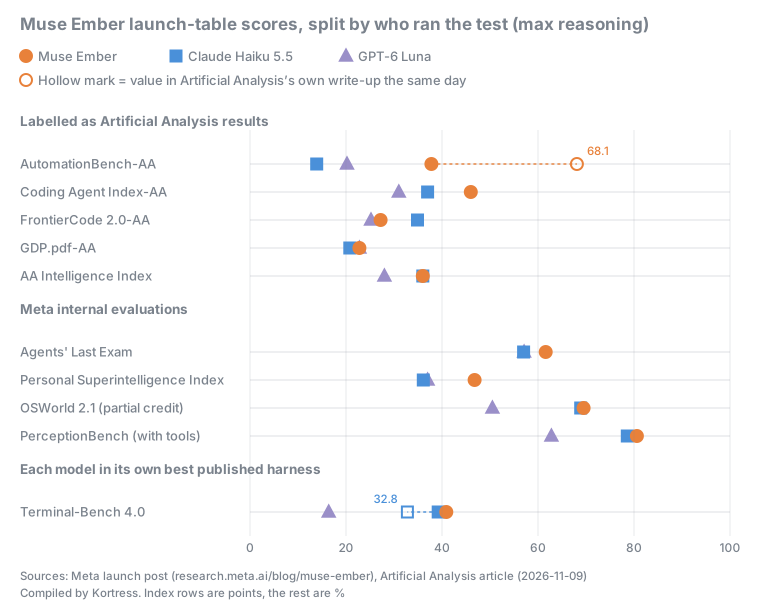
Of the five rows labelled as AA results, Ember clearly beats Haiku 5.5 in two: AutomationBench-AA and the Coding Agent Index-AA. Haiku 5.5 wins FrontierCode 2.0-AA (34.9% vs 27.2%), and GDP.pdf-AA is a 2.0-point gap. The Intelligence Index is a 36–36 tie after rounding. The chart data on the same page lists Ember (max) at 35.8 and Haiku 5.5 (max) at 36.2, so Haiku 5.5 is 0.4 points ahead before rounding. Ember's widest lead, on the Personal Superintelligence Index (46.8 vs 36.1), is what Meta's footnote calls an internal composite of eight evaluations, including Agents' Last Exam, AutomationBench and FocusBench. Nobody outside Meta can reproduce it today.
The Coding Agent Index-AA was measured by a third party but under unequal conditions. AA ran Ember in Meta's Muse Code, Haiku 5.5 in Claude Code and Luna in Codex. It is better read as a score for each model paired with its vendor's coding tool than as a model-only score.
Same benchmark, different numbers
Meta's launch post and AA's article came out on the same day, and Meta credits AA for several rows. Read side by side, they disagree in three places.
| Item | Meta | AA article |
|---|---|---|
| AutomationBench-AA, Ember (max) | 37.8% (captioned "Strict pass@1") | 68.1% |
| Terminal-Bench 4.0, Haiku 5.5 (max) | 39.2% (Claude Code harness) | 32.8% (AA index run) |
| Cost per task, Ember (max) | ~$0.14 research post, ~$0.13 developer post | $0.14 |
Sources: Meta research post, Meta developer post, Artificial Analysis article
AutomationBench-AA shows the widest gap. Meta's chart for that row is captioned "Artificial Analysis | November 9, 2026. Strict pass@1" and gives Ember 37.8%. AA's article says Ember (max) scores 68.1%, level with Muse Wonder (max). The two figures appear to come from different scoring rules, but AA's article does not state its scoring method, so we could not confirm which figure measures what. Either way, Ember stays ahead of Haiku 5.5 and Luna within Meta's table. AA's article gives no AutomationBench numbers for Haiku 5.5 or Luna, so the 68.1% cannot be compared against them.
For Terminal-Bench 4.0, only Meta's conditions are documented. Meta's footnote says each model ran in its best published harness: mini-swe-agent for Ember, Claude Code for Haiku 5.5, Codex for Luna. AA reports 40.9% for Ember and 32.8% for Haiku 5.5 in its own index run, but does not say which harness it used. The same Haiku 5.5 differs by 6.4 points between the two documents. The harness is the likely cause, but that is not confirmed. On Meta's table, Ember leads Haiku 5.5 by 1.7 points. On AA's run, the lead is 8.1 points.
The $0.13 vs $0.14 cost figures come from two posts by the same company. The research post's chart data lists the max-effort point at $0.136, so this looks like rounding. Meta labels these costs as estimates.
What the small model gives up
AA names knowledge as Ember's main weakness. On AA-Omniscience, a factual-recall benchmark, Ember answers 21.1% correctly, the lowest among the similarly intelligent models AA compared. Claude Haiku 5.5 (max) gets 34.7% and Gemini 3.8 Flash (high) 50.5%.
The low accuracy mostly comes from refusing to guess. Per AA, Ember declines 64% of questions, which keeps its hallucination rate at 17.4%, about half of Haiku 5.5's. That lines up with Meta's own advice to send knowledge-heavy questions to Spark or Wonder. Our read is that tasks where the answer sits in the input, such as extracting fields from a document or running tests, will hide this weakness. Questions that depend on what the model already knows will see "I don't know" often.
Within Meta's lineup, AA puts Ember (max) at 36 points for $0.14 per task and Muse Wonder (max) at 44 points for $6.95. That is 8 points for roughly a fiftieth of the cost. In the AA comparison on Meta's launch post, Muse Spark 1.3 (max) scores 37 at $2.39 per task, one point above Ember.
Developer reaction
The Hacker News launch thread (330 points) split along predictable lines.
Price drew the praise. User slopnt wrote, "I use haiku and luna for support on most my SWE tasks since they are cheap and fast… the fact an even cheaper model for comparable intelligence is out there now is great news!" (comment). User minimaxir pointed out that cached input costs 4% of the input price, against 10% for Luna and Haiku (comment).
The scepticism centred on long tasks and openness. OpenRouter says its stealth model "Crouton Alpha" was an early version of Muse Ember (OpenRouter). User OsrsNeedsf2P, who had used it, wrote: "It starts strong, but by turn 10 is quite bad, and by turn 20 is unusable. Good for short tasks. Horrible for long." (comment). That is one person's experience with a pre-release build, so it may not carry over. Others lamented the lack of weights ("No weights? Shame", comment), and Simon Willison reported that across six effort levels on his drawing test, the high setting did not return a complete SVG (comment).
At the time of writing we found no substantial Reddit discussion we could read in the original.
What it changes for teams outside the US
For teams picking a cheap subagent model, Ember adds a third option at the same list token prices as Claude Haiku 5.5 and GPT-6 Luna. Access is the first thing to check. Meta's geographic use policy lists restricted territories (China, Russia, North Korea and others), and South Korea is not among them. However, Meta publishes no official list of enabled countries and reserves the right to change access at any time. The policy was last updated on October 12 and does not yet list Ember among its model designations.
Our assessment is that Ember fits best as the worker in a split setup. A larger model runs the main loop, and Ember gets high volumes of short tasks whose evidence is already in the prompt, such as document extraction, ticket triage, and run-the-tests-and-fix loops. Meta's docs, AA's knowledge results and the community's long-session anecdote all point the same way. For work that leans on the model's own knowledge, such as customer support in a non-English language, or for a standalone agent running dozens of turns, the evidence is still thin.
One pricing detail is easy to miss. Any request with more than 200,000 input tokens is billed entirely at the long-context rate ($0.30 input, $1.50 output per million tokens), not just the part above 200,000. When you chain turns with previous_response_id, the whole conversation counts as input. So a long session kept in one thread will triple its per-request price at some point, despite the context window of about one million tokens. That is another reason to hand Ember short, self-contained subtasks.
Limitations
| Item | Detail |
|---|---|
| No direct measurement | We did not call Ember ourselves. All performance figures are from Meta and AA |
| AutomationBench-AA gap | We could not confirm which scoring rule produced 37.8% and which produced 68.1% |
| No non-English evals | Neither Meta's post nor AA's article reports performance in Korean or other non-English languages |
| Access | South Korea is not on the restricted list, but we did not test key issuance or API calls from Korea |
| Community sample | Quotes are individual comments from one Hacker News thread. The long-session complaint concerns a pre-release build |
Internal indices like the Personal Superintelligence Index list their component evaluations but not their weights or items. Until a third party re-runs them, treat those gaps as Meta's claims. We looked at another split between vendor and independent scores in our Kimi K3.1 Pro piece.