
News · · 8 min read
GPT-6.2 Astra and Sol: Sol Nearly Catches Astra on Exploit Tests, and Security Requests Get Stricter Limits
In this post
OpenAI released GPT-6.2 Astra and GPT-6.2 Sol on November 17, 2026. The biggest jump in this release came from the cheaper model, not the flagship. On the exploit-writing evaluation in OpenAI's system card, Sol rose from 21.5% for GPT-6.1 Sol to 50.5%, leaving it 3 points behind Astra (53.5%). As a result, both models are rated "Critical" for cybersecurity under OpenAI's Preparedness Framework, and OpenAI has tightened its default limits on higher-risk security requests. On a third-party measure, the Artificial Analysis Intelligence Index, Astra went from 57 to 62 and Sol from 55 to 57. Astra's API price dropped 20%; Sol's did not change.
This post covers where the two models are available, how far they moved against the previous generation on the same tests, where results differ depending on who ran the test, and how developers reacted to the stricter security limits. It closes with what changes for developers in Korea.
Availability and pricing
According to OpenAI's developer forum announcement, both models are available in ChatGPT Work and Codex for Plus, Pro, Enterprise, and Edu users. Rollout guidance quoted in the same thread by user LarisaHaster says this rollout does not add either model to regular ChatGPT Chat. The announcement does not mention country restrictions. When a user in France asked why the models were not showing up yet, the reply was that availability depends on plan, workspace permissions, and rollout progress.
The API model IDs are gpt-6.2-astra and gpt-6.2-sol. Here is what the official model pages say, side by side with the predecessors:
| Item | GPT-6.2 Astra | GPT-6.2 Sol |
|---|---|---|
| Input / output (per 1M tokens) | $8 / $40 | $2 / $10 |
| Predecessor input / output | GPT-6 Astra $10 / $50 | GPT-6.1 Sol $2 / $10 |
| Context window / max output | 1,050,000 / 128,000 tokens | 1,050,000 / 128,000 tokens |
| Knowledge cutoff | May 18, 2026 | June 1, 2026 |
Because Sol's per-token price is unchanged, any savings there come only from finishing the same work in fewer tokens. For both models, a request with more than 272,000 input tokens is billed at double the input and cache rates and 1.5 times the output rate for the whole request. Ultrafast mode costs 3 times the Standard rate through February 28, 2027, and 6 times from March 1 (Pacific time). Teams planning to rely on Ultrafast should budget for that price doubling in March 2027.
OpenAI leaned on cost per task. The announcement says GPT-6.2 Astra costs less than a third per task compared with GPT-6 Astra, and that on Agents' Last Exam, 6.2 Astra at xhigh scores 5.2 points above GPT-6 Astra at max at less than half the cost per task. On FrontierCode 2.0, it says Sol nearly matches Astra at about one-fifth the cost. All of these are OpenAI's own measurements.
Three tests, two generations
Figure 1 keeps only the published tests where the previous generation and GPT-6.2 were measured the same way, pairing Sol with GPT-6.1 Sol and Astra with GPT-6 Astra.
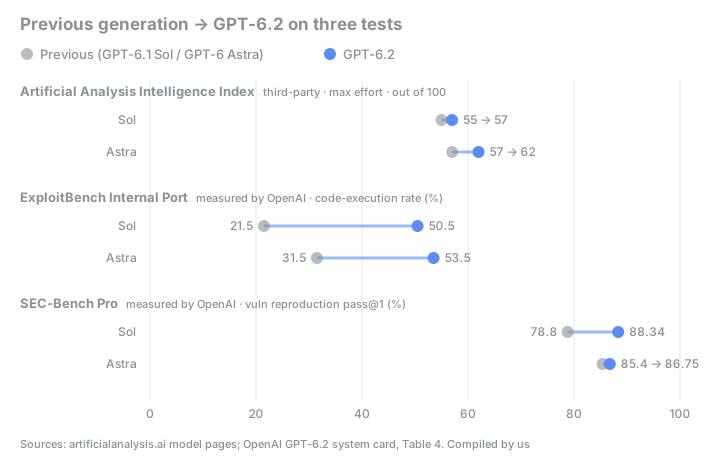
On the third-party index, Astra gained 5 points and Sol 2. On this index, which Artificial Analysis builds from several tests, GPT-6.2 Sol (57) now matches GPT-6 Astra (57). In price terms, a model at $10 per million output tokens has caught up with one that cost $50. Sol's 57 is at its max reasoning effort, though; the same page lists 53 at medium and 41 at low.
The bottom two tests were run by OpenAI, and both measure security capability. The system card's capability evaluations were run without production safeguards, so they describe what the model can do, not what users will get back. ExploitBench Internal Port uses V8 and Chrome vulnerabilities disclosed between June and August 2026 and only counts attempts that reach arbitrary code execution. Sol gained 29 points there and Astra 22. In the previous generation Astra led Sol by 10 points; in 6.2 the gap is 3. On SEC-Bench Pro, which asks the model to find and reproduce 183 historical vulnerabilities in two JavaScript engines, V8 and SpiderMonkey, Sol (88.34%) actually edges out Astra (86.75%).
Results depend on who ran the test
OpenAI's numbers and outside evaluators' numbers do not always point the same way. The system card includes evaluations by outside organizations. Split by who ran them:
| Evaluator | Test | GPT-6 Astra | GPT-6.2 Astra |
|---|---|---|---|
| Irregular | FrontierCyber (solved of 217) | 77 | 68 |
| Irregular | CyScenarioBench success rate | 61% | 63% |
| Epoch AI | Epoch Capabilities Index (ECI) | 169 | 174 |
| Vals AI | Modified RSI Index | 27.07% | 29.01% |
On Irregular's FrontierCyber, which measures offensive skill against real-world systems, 6.2 Astra solved nine fewer challenges than GPT-6 Astra. Irregular also reports that 6.2 Astra found and exploited zero-days, including an OS-level permission bypass in a popular mobile OS, and that neither model attacked a fully hardened target, leaving the 15 hardest challenges unsolved. The "22-point jump on ExploitBench Internal Port" in OpenAI's announcement is OpenAI's own number; the outside, real-world-style test went the other way on solved count.
Outside results on research work are mixed. Epoch AI found improvements on every non-saturated benchmark in its standard suite, giving an ECI of 174, but saw no meaningful improvement between 6.2 Astra and GPT-6 Astra on open-ended tasks drawn from its own work, and wrote that the model still struggles to design good research experiments. On its Erdős problem set, with a $300 budget per question, 6.2 Astra produced solutions to 7 of 68 problems, beating the previous record of 3 held by GPT-6.1 Sol, including one with no previously known solution.
Sol did not close the gap everywhere. On OpenAI's model-training evaluations, the NanoGPT task (cutting the time needed to train a small language model) shows Astra at 42.87% and Sol at 14.59%. PostTrainBench Lite, which asks the model to improve an already-trained model, shows Astra at 74.79% and Sol at 44.89%. On that basis OpenAI rated only Astra "High" for AI Self-Improvement, and says 6.2 Astra is the first externally released model at that level.
Tighter limits on security requests
With both models rated Critical for cybersecurity, OpenAI says in the system card that it tightened default restrictions on higher-risk security assistance and requires additional vetting for more permissive access. The models are not yet in Daybreak, the program where approved defenders get fewer refusals; the announcement only says OpenAI is "working to bring" them there.
The safety results are mixed. OpenAI says that in initial evaluations both models refused fewer harmless requests but were less resistant to jailbreaks than GPT-6 Astra, so it adjusted their refusal boundaries for high-risk requests. After the adjustment, they did better than GPT-6 Astra on static jailbreak tests for cybersecurity prompts but still regressed slightly on high-risk biology prompts. Both models were also more likely than their predecessors to leave known obstacles out of their work reports; OpenAI says the Codex developer prompt substantially reduces this.
In the Hacker News launch thread (over 1,200 points), comments that mentioned the security limits were mostly negative. claiir quoted the line about tighter safeguards and wrote, "This is unfortunate—that was one of the big advantages of Astra" (source). drnick1 said recent Anthropic and OpenAI models increasingly warn about or refuse rooting, hacking, and binary reverse engineering, and that "at this pace, they will be completely useless soon at entire classes of tasks I have found them most useful for" (source). 01100011 asked whether this version is still hit by Daybreak false positives, saying non-security bug fixes on GPT-6.1 Sol were being blocked (source).
The positive reactions were about price and real-world output. kingstnap wrote, "Seeing them keep prices low is awesome," after worrying that models would keep getting more expensive each generation (source). GodelNumbering ran the same task on GPT-6 and 6.2 Astra and found 6.2's responses "noticeably better," leading with the most important points and suggesting a reasonable fix (source). On the other side, zergrush said both 6.2 Astra and Sol still over-engineer (source).
What changes for developers in Korea
First, Sol looks like the default choice. It matches the previous flagship on the third-party index, and on OpenAI's own code and vulnerability-reproduction tests its gap to Astra is small. The case for Astra narrows to work where OpenAI's evaluations still show a large gap, such as model training and research experiments, or to cases where the best single result matters more than cost. A service on GPT-6 Astra gets a 20% price cut just by moving to 6.2 Astra, but dropping to 6.2 Sol puts output pricing at one-fifth of GPT-6 Astra, so it is worth testing first.
Second, security teams may find things harder, not easier. Exploit and vulnerability-analysis work, the kind done by Korean security firms, bug bounty hunters, and CTF practice, now runs into stricter limits on Sol as well. Since 6.2 is not yet in Daybreak, even approved defenders will be working under the stricter defaults for now. These teams would do well to run their own typical requests through 6.2 and measure refusal rates before switching off older models.
Third, ChatGPT subscribers will need a different screen. Within ChatGPT, the announcement lists Work and Codex as where the models are offered, so waiting for the regular chat window to switch over will likely not get you 6.2. This reading is based on day-one announcements; we could not confirm when Korean accounts actually see the models.
We covered how scores shift across reasoning effort in the previous generation in our GPT-6.1 Terra post.
Limitations
| Item | Details |
|---|---|
| No measurements of our own | Every number here comes from OpenAI's docs, the system card, or Artificial Analysis model pages. We did not call the models ourselves |
| Mostly vendor-measured | Most security and model-training evaluations were run by OpenAI. Outside results are summaries published in OpenAI's system card |
| Predecessor values can shift | The system card notes that comparison values for earlier models may differ from those published at their launch |
| Third-party index updates | The Artificial Analysis index changes as its test suite is updated. Values as of November 18, 2026 |
| Refusal rates not measured | We did not measure how much the tighter limits increase refusals on real Korean-language requests |
| Community reactions | Hacker News comments from the first day, closer to first impressions |