
News · · 10 min read
OpenAI and Cisco Release Shirudo: eBPF Shields for Unpatched Linux, and What the Docs Require
In this post
OpenAI and Cisco released Shirudo, an open-source runtime, on November 23, 2026 (US time). It is meant to cover the days or weeks that testing and rolling out a patch can take, by attaching temporary protections, called shields, to a running Linux system without a restart. The announcement reads as if you could drop it onto the servers you run today. The project's own documentation says otherwise. A target must boot a development bpf-next kernel with the signed-loader ABI and must have a TPM 2.0. There is no software release yet, and the FAQ answers "Is shirudo ready for production?" with "Not yet."
This article puts the announcement and the documentation side by side, looks at what the headline demo shield actually was, places Shirudo next to existing Linux security mechanisms, and covers the published overhead numbers, the Hacker News discussion, and what it means for teams running Linux in production.
What Shirudo does
A patch that exists is not a patch that is deployed. OpenAI's announcement notes that testing and rolling out a patch can still take days or weeks, and that protecting a service in the meantime is hard because an exploit and a legitimate request may rely on the same Linux operation. Blocking that operation outright can take the service down.
Shirudo approaches the gap with eBPF, the Linux technology that runs small programs at specific points inside the operating system. A shield is a temporary safeguard scoped to the path a vulnerability needs, and the announcement describes it as an eBPF program. Operators test whether a shield blocks the exploit while letting real traffic through, approve it, and deploy it while the service keeps running. The announcement lists four core capabilities.
| Capability | As described in the announcement |
|---|---|
| Live protection | eBPF shields block vulnerable code paths without a restart. Teams can watch a proposed shield's effect before enforcing it |
| Defense at machine speed | Agents get programmable controls to investigate vulnerabilities, build shields and validate them. Security teams decide what is deployed |
| Trusted deployment | Shields are cryptographically signed and verified before loading. The kernel's eBPF verifier checks them against its safety rules |
| Hardware-backed verification | A TPM keeps a verifiable record of shields being loaded or removed |
Shirudo is licensed under BSD 2-Clause, with its BPF programs dual-licensed under BSD and GPL, and it costs nothing to use. A same-day blog post from Isovalent, the Cisco-owned eBPF company, says Shirudo has its roots in Isovalent's Tetragon and is a rewrite of it designed for agents.
The announcement versus the documentation
The announcement says Shirudo protects "running Linux systems" but does not say which ones. The conditions live in the system requirements, FAQ and versioning pages at docs.shirudo.dev. Here is the same set of questions answered by each source, compiled by us.
| Question | Announcement | Documentation |
|---|---|---|
| Target kernel | Not stated | A bpf-next kernel with the signed-loader ABI, plus carried patches such as a tpm_command LSM hook. No compatibility mode or fallback for older kernels |
| TPM | Used to record loads and removals | TPM 2.0 is required on every target. There is no mode without one |
| Maturity | An invitation to help develop it | No software release. Only the main development branch, with no format compatibility promise. Production-ready: "Not yet" |
| Signing keys | Shields are signed | ML-DSA-87 only, a post-quantum algorithm. Existing keys are refused |
| Other eBPF tools | Not stated | Cilium, Falco and bpftrace do not run as they are, because only BPF from signed loaders is admitted |
| Architectures | Not stated | x86-64, arm64 and riscv64. CI tests x86-64, the test VM also runs on arm64, and no riscv64 target has booted yet |
The kernel requirement is the biggest gap. The docs explain that a development-tree kernel cannot be identified by its release number alone, and their test kernel reports itself as 7.4.0-rc1-bpf-next+. Production kernel builds come from a separate repository, shirudo-dev/kernel. In practice, adopting Shirudo means booting that kernel instead of your distribution's.
The second gap is coexistence. Shirudo protects itself by refusing any BPF that a signed loader did not install. The FAQ therefore says tools that load their own programs, naming Cilium, Falco and bpftrace, fail at their first map or program, and suggests reimplementing their logic as signed upatches (Shirudo's unit of signed BPF).
What the demo shield actually was
The announcement's one result is a controlled test in which a shield generated by OpenAI Codex blocked a Java4Shell exploit attempt against a running Elasticsearch service, with no restart. The body text says the shield added an input check to Java's Base64 decoder and was attached directly to the running Elasticsearch process.
That shield was not an eBPF program. Isovalent's post on the same test says the resulting mitigation was "written as Java bytecode", injected into the Java application to validate Base64 input, and tested on Elasticsearch 9.5.5. Two lines from the Elasticsearch log in that post carry the result.
"Base64 guard installed on java.util.Base64$Decoder.decode0 (classfile)"
"Base64 guard rejected candidate: length=65, padding=1, remainder=1, alphabet=standard"
The first line shows where the shield attached; the second shows it rejecting the exploit input. Isovalent describes bytecode changes as the route for vulnerability classes that do not suit eBPF, and the docs carry a separate section on Java agent upatches. Shirudo looks less like an eBPF-only tool than a signing, loading and attestation framework that carries two kinds of shields: eBPF programs and runtime bytecode.
There is also a baseline to compare against. Elastic's November 18 advisory (CVE-2026-114938) says only Elasticsearch nodes on x86-64 CPUs that support AVX512_VBMI are affected, with ARM and older x86 not affected at this time. Its official mitigation is adding the JVM option -XX:-UseBASE64Intrinsics and restarting the node, and it notes that a rolling restart avoids cluster downtime. The real fix bumps the bundled JDK to 27.0.1.1. The advisory lists 8.19.26, 9.4.10, 9.5.7 and 9.6.0 as the releases carrying it, and when we checked the Elasticsearch release notes on November 24, 9.5.7 and 9.4.10 were already listed with that JDK bump. So what the demo saved was a per-node restart rather than an outage; a multi-node cluster with replicas could likely already have been protected without downtime the conventional way.
The evidence is thin. The test was a single run by OpenAI and Isovalent themselves, we found no independent reproduction, and Isovalent's own wording is that the mitigation "appears to be effective."
How it relates to existing Linux mechanisms
There are already several ways to change kernel behavior without a reboot or to control which code runs. Shirudo's comparison page states, for each one, whether Shirudo complements it, builds on it or takes its place. Our summary:
| Existing approach | What it does | Relationship per the docs |
|---|---|---|
| Kernel live patching | Redirects calls to a fixed function | Complements. A upatch cannot replace a function body; it can refuse a call before it runs, or observe and filter. Both can run together |
| IMA and IPE | Measure or gate file execution and loading | Complements. Neither covers BPF loaded through bpf() |
| Policy engines on the BPF LSM | Watch and enforce runtime policies | An engine that loads its own programs cannot run on an enforcing target. Its logic can be rewritten as upatches |
| Signed BPF in the kernel | Verifies a loader's signature and records the verdict | Builds on it. Shirudo is the LSM that acts on the verdict |
The picture is a stopgap that holds the line until the fix lands. The FAQ says plainly that Shirudo does not replace kernel updates and that a upatch covers the time until the machine runs a kernel with the fix. Live patching carries the fix itself; Shirudo blocks the path until then and is removed with a signed unload once the fix is in.
Published overhead from one machine
The only performance numbers published are about Shirudo's own cost, not about how well shields defend. The docs' Overhead page reports wall time and memory per command, measured on a single test VM. We charted the timings below.
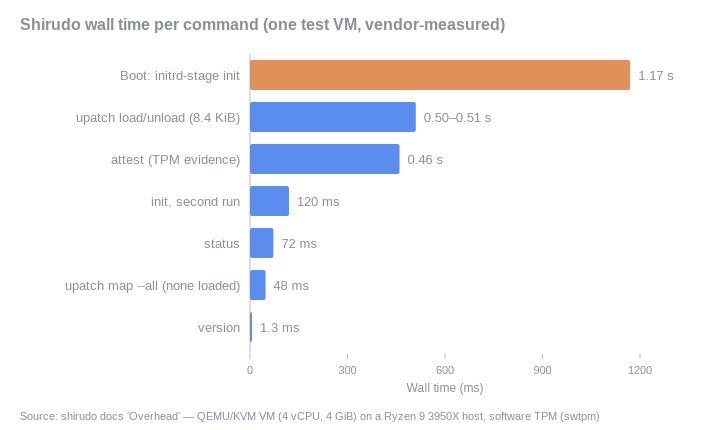
The longest step was initialization in the initrd at boot, 1.17 seconds. Loading or unloading an 8.4 KiB upatch took 0.50 to 0.51 seconds, and producing TPM evidence with attest took 0.46 seconds. No Shirudo process runs between commands, according to the docs. Periodic work is done by four timers that start a new process on each run, and in a measurement with the keepalive timer running every 5 seconds they used 0.43 seconds of the test VM's CPU time per minute, 0.71% of one vCPU. The docs say the keepalive now runs once a minute but adds a TPM quote each time, which this measurement does not include, so the cost under default settings may differ. The memory peak during a upatch load was 29.7 MiB.
These numbers travel poorly. They come from one VM with a software TPM (swtpm), and loads and unloads were single runs. The docs themselves say other CPUs, kernels, disks and TPMs give other numbers and that every TPM command takes as long as the TPM takes to answer. How much a shield slows the protected service depends on how the upatch is written, so there is no general figure. No third-party measurements exist yet; these are vendor numbers only.
First reactions from operators
The Hacker News submission had 67 points and 19 comments when we checked on November 24 (thread). The comments quoted below dwell less on the idea than on deployment conditions and trust.
User p0lychromatic wrote that reading the requirements made them "nope out": "This basically requires a full measured boot setup (TPM2, unified kernel image etc.). This is definitely not a simple 'vibe-code your patch' platform you can deploy in an emergency." They added that an organization with that setup probably does not struggle to deploy patches quickly anyway (comment). User fathermarz worried it could become "an escape hatch for swamped teams that never actually harden their systems" (comment). User rkagerer felt that getting real value would mean handing an AI vendor a lot of telemetry and control (comment).
On the positive side, user bpbp-mango wrote that it "seems really useful" and wondered whether big security vendors will sell upatch subscriptions (comment).
The most detailed critique, from user jiveturkey, was harsh. They found the agentic part had no substance yet and noted that, contrary to the label, it is "not just eBPF-based" and patches Java apps through Java's own mechanism. They called those Java upatches "very valuable", but argued that the signing and TPM verification the project invested most in "nearly never matters" for typical operators, and closed with "Verdict: slop" (comment). The Java point matches the demo section above.
In the press, Simon Sharwood of The Register wrote that the open-source offer "is not entirely altruistic": wider adoption could raise demand for Codex, and Cisco owns Isovalent, which created Tetragon, and uses eBPF in other products (article).
What it means for teams running Linux today
If your servers run your distribution's stock kernel, Shirudo does not appear deployable on them today. The docs offer no fallback for older kernels and there is no release. On cloud VMs, whether a TPM 2.0 is available is the next question. It seems more accurate to read this release as a design preview of where patch operations may be heading than as a tool that closes the patch gap now.
Kubernetes teams using Cilium have a direct conflict to weigh. The docs say Cilium does not run as it is on a node Shirudo enforces. Both projects come from the Cisco side, so a bridge may appear later, but as documented today a node has to pick one.
It is also worth asking whether an AI subscription is required. The demo used Codex as the control plane, but the docs describe a upatch as plain BPF C, include a tutorial that writes one by hand, and say the platform does not understand what a upatch does; it only makes sure signed ones run. Shirudo therefore appears usable without OpenAI's models. Separately, Hacker News user siliconc0w wrote that OpenAI's guardrails blocked them while building similar purely defensive patches (comment), They describe that as happening "a few months ago", so it may predate the November tightening covered in our GPT-6.2 Astra and Sol article. Since restrictions have only grown stricter since, teams planning agent-generated shields should test refusal rates as well.
What you can do now is learn the model in a lab. The quickstart boots a test VM on an x86-64 or arm64 Linux host with KVM and takes one upatch through signing, loading, verification and unloading, and Isovalent offers a browser-based lab. A technical webinar is scheduled for December 15. OpenAI and Cisco name publishing tested shields alongside vulnerability disclosures as a goal; when those shields start appearing looks like the right moment to reconsider adoption.
Limitations
| Item | Detail |
|---|---|
| Not run by us | We did not build Shirudo or load a shield. The comparison tables come from the announcement and the documentation only |
| Performance data | Defense effectiveness rests on one vendor-run test; overhead numbers come from one vendor test VM. We found no third-party measurements |
| Moving docs | With no release, the requirement pages may change often. Tables reflect the docs as checked on November 24, 2026 |
| Community reactions | Quoted comments are individual opinions. We found no substantive Reddit discussion |
| Cloud conditions | We did not check which cloud providers offer TPM 2.0 or allow booting a custom kernel |