
News · · 7 min read
Skills over MCP and Tasks arrive in Claude: what server developers must rewrite, and who gets what
In this post
On November 24, 2026 (US time), Anthropic marked the second anniversary of the Model Context Protocol (MCP) by widening Claude's MCP support. Skills over MCP, which lets an MCP server ship skills alongside its tools, is now in public beta. Tasks, for handing off long-running work, and Elicitation, for asking the user for input mid-call, are generally available. File Uploads, which sends files to a server, is only announced as "rolling out soon." For people who run MCP servers, the real work is in Tasks: servers built against the experimental Tasks in the 2025-11-25 spec need to be reworked for the extension, whose methods have changed.
This post covers which plans get each feature, the conditions the spec places on server-shipped skills, how experimental and extension Tasks differ, what changes for developers in Korea, and early developer reactions.
Status and plan coverage by feature
Anthropic's announcement gives a different status and plan list for each of the four features. Lining up its sentences on the same axes gives this table, compiled by us.
| Feature | Status in Claude | Pro, Max, Ultra | Team, Enterprise |
|---|---|---|---|
| Skills over MCP | Public beta | On by default | Team: admin must enable; Enterprise: "coming soon" |
| Tasks | Generally available | Available | Rolling out |
| Elicitation | Generally available | Available | Rolling out |
| File Uploads | Rolling out soon | Planned | Planned for eligible organizations |
All four features target the Claude apps and Claude Code. Pro, Max and Ultra can use the GA features today; Team and Enterprise organizations are a different story. On Team, Skills over MCP stays off until an admin turns it on, and Enterprise gets only an undated "coming soon." The announcement says nothing about regional restrictions.
The announcement also names servers already using each feature. Shopify, HubSpot and Atlassian ship skills, with Carta "coming soon." ZoomInfo uses Tasks for account and contact research. With Elicitation, Supabase confirms costs before creating a paid project and before running destructive SQL, and GitHub has users type a repository's name before an agent deletes it.
What it means for a server to ship skills
Tool names and descriptions tell a model what a server can do, not in what order or under which conditions to use those tools. Skills over MCP lets the server ship that know-how as skills. A skill is a directory with a SKILL.md and optional supporting files, following the Agent Skills specification. We covered that specification's move to a Linux Foundation body in our post on the Agent Skills donation.
In the spec, this is the io.modelcontextprotocol/skills extension. Its proposal, SEP-2640, is Final, but the extension itself sits at the Beta stage of MCP's extension lifecycle, and its repository warns that a Beta revision may make breaking changes. A server declares the resources capability together with the extension and implements skills/list and skills/get; the files themselves are read through the existing resources/read. Anthropic says Claude loads a skill only when it is needed, keeping context use low. The spec points the same way: a host (the client app, such as Claude) must not fetch files ahead of need, including on connection, listing or approval.
The rules with the most operational weight are integrity and approval. For a skill made of fixed files, skills/list must return a manifest of every file's URI, SHA-256 digest and byte size. The host checks size and digest before using a file and refuses content that fails. A persisted approval is bound to that full set of URIs and digests. If any file is changed, added or removed, the approval is revoked and the host must ask again.
The spec is blunt that skill content is untrusted input. Host-side code execution and permission grants such as allowed-tools require explicit per-skill user approval, and hosts must stop same-named skills from silently replacing each other. Servers should keep a single skill under 512 files and 16 MiB. Skills whose content is generated on the fly are marked "dynamic" instead of carrying a manifest, and hosts may decline them.
Experimental Tasks versus the extension
Tasks first appeared as an experimental feature in the 2025-11-25 spec. The 2026-07-28 spec moved it out of the core protocol into the official io.modelcontextprotocol/tasks extension and redesigned it (SEP-2663). We compared both versions' spec pages and the changelog on the same axes.
| Item | 2025-11-25 experimental | 2026-07-28 extension |
|---|---|---|
| Where it lives | Experimental core feature | Official extension io.modelcontextprotocol/tasks |
| Getting the result | Blocking tasks/result | Replaced by polling with tasks/get |
| Client-to-server input | No tasks/update | New tasks/update method |
| Listing tasks | tasks/list | Removed |
| Creating a task | Requestor augments requests with tasks | Server decides per request; client declares the extension once |
The rows that changed are the wire methods themselves. Servers and clients written against experimental tasks/result or tasks/list appear unlikely to interoperate with an extension-based peer as-is. The 2026-07-28 spec also dropped the initialize handshake and went stateless, with each request carrying its protocol version and client capabilities in _meta, so the job is following the whole revision, not just patching Tasks. Anthropic says the latest spec is supported across Claude products.
The extension defines five task states. The diagram below shows how they connect.
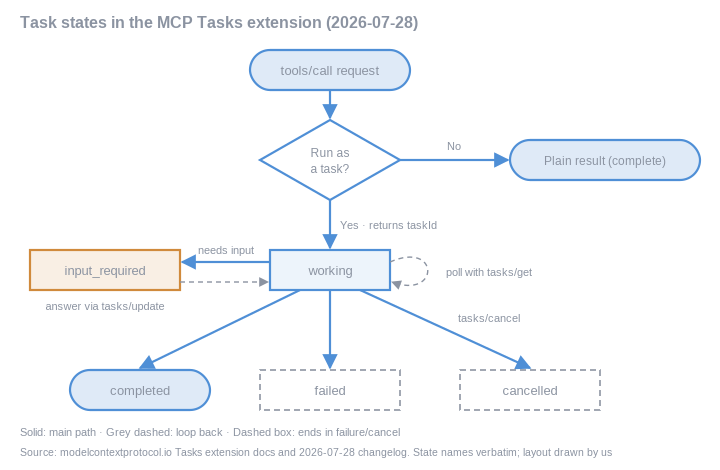
The moment a task needs input is where Tasks and Elicitation meet. When a task moves to input_required, the tasks/get response carries the input requests; the client collects answers from the user and sends them back with tasks/update. No second connection or unsolicited server message is involved. Cancellation is cooperative: a client can send tasks/cancel, but the server is not obliged to stop the work.
What changes for developers in Korea
For developers who have wired Korean services into MCP servers, the biggest change is that the usage guide can now ride along with the server. Until now, knowledge like "call these tools in this order" had to be installed by users as a separate skill or written into prompts. Now the skill updates with the server and users have nothing extra to install, so a server team can maintain workflows tailored to Korean-language business processes on its own side.
The trade-off looks like a cost per edit. Because approval is bound to the digest set, changing even one character of a skill file means users will be asked to approve again. The announcement does not say how Claude presents that re-approval. Teams that edit skills often will likely spare their users by batching changes into fewer releases.
Servers that already implement experimental Tasks need a migration plan: swap tasks/result for tasks/get polling, remove anything that depends on tasks/list, and make clients persist task IDs so polling can resume after a reconnect. Organizations on company plans should watch the schedule too. Team admins must switch skills on, Enterprise has no date for skills, and Tasks and Elicitation are still "rolling out" for both. Korean B2B services that want to reach Enterprise customers first will likely end up validating on Pro, Max or Ultra accounts before that.
None of this is Claude-only; these are parts of the open MCP spec and its extensions, and the announcement says a server that supports them works in any compatible client. That said, MCP's extension support matrix is marked as community-maintained, and the Skills extension page says SDK and host support is still being implemented. A server aiming beyond Claude should check each client directly.
Developer reactions
Two days in, there is little reaction. As of November 26, the Hacker News submission of the announcement had 5 points and no comments.
In a DEV Community post, Max Quimby wrote this about Tasks' explicit states and resuming with the same task ID:
"This is the right architectural decision." — Max Quimby, DEV Community
The same post also points to a gap: Tasks gives servers a state machine for reporting progress, but does not define what the client shows the user.
"It says nothing about what the client does with that information — specifically, what the user sees." — same post
An older debate connects to this launch as well. In a September Hacker News thread, anon84873628 argued that Skills over MCP would solve distributing skills service by service:
"With MCP, all you have to do is provide the harness with a single URL and all context can be bootstrapped the same way for every service." — anon84873628, Hacker News
That comment predates the launch. We have not yet found hands-on reports on whether it works that way in practice.
Limitations
This post is based only on Anthropic's announcement and the MCP spec pages. We did not build an MCP server and connect it to Claude ourselves.
| Item | Status |
|---|---|
| Performance numbers | These are protocol features, so there are no benchmarks. The claim that tool search "can cut the context they use by over 85% in multi-server setups" is Anthropic's; we found no third-party measurement |
| Re-approval UX | The spec requires re-approval, but how Claude shows it is not public |
| Other clients | MCP's support matrix is community-maintained, and we did not verify per-client support |
| Schedule | Team and Enterprise rollouts and File Uploads have no dates |
| Community reaction | Two days after launch, the sample is small |
The announcement also says MCP sees over 700 million monthly SDK downloads and that Claude has over 10,000 MCP connectors. Those are Anthropic's figures as well.
Sources: Anthropic, "MCP servers can now ship skills, run tasks, and more with Claude" · MCP Skills extension · MCP Tasks extension · MCP 2026-07-28 changelog · MCP 2025-11-25 Tasks (experimental) · MCP extension support matrix