
News · · 8 min read
Korean in Nemotron 3.5 Transcribe: What the Support Matrix Claims and What Was Measured
In this post
On October 28, 2026, NVIDIA released Nemotron 3.5 Transcribe, an open-weight transcription model for recorded audio. A single model handles transcription in 40 languages, speech translation to and from English, speaker-attributed transcription, and word-level timestamps. In the model card's language matrix, Korean sits in the top "Leading" tier with a check mark in all four columns: transcription, translation, multi-speaker transcription, and code-switching. Cross-check that against the benchmark section of the same model card, though, and Korean numbers exist for only three things: transcription, translation, and language identification. There is no Korean measurement for speaker-attributed transcription, which meeting notes depend on, or for Korean speech mixed with English.
This post lines up claims against measurements for each Korean capability, places the Korean error rate among the model's other languages, looks at what an independent index says about open-weight accuracy, covers the hardware requirements, and summarizes the Hacker News discussion.
Korean support claims versus published measurements
Nemotron 3.5 Transcribe is a speech language model: it takes a recording plus a text instruction and returns text. The same recording can come back verbatim, cleaned of filler words, tagged by speaker, or translated into English, depending on what the request asks for. NVIDIA published it on build.nvidia.com, GitHub (NeMo Speech), Hugging Face, and NGC on the same day.
The language matrix marks each capability with a check. We matched it against the Korean rows in the model card's own benchmark section:
| Capability | Matrix for Korean | Korean result in the model card |
|---|---|---|
| Transcription | Supported | FLEURS character error rate (CER) 2.78% |
| Speech translation with English | Supported | FLEURS Korean→English BLEU 24.23, English→Korean 27.68 |
| Multi-speaker transcription | Supported | None. Only six English and two Mandarin benchmarks |
| Code-switching | Supported | None. Only Mandarin, Bengali, and Hindi paired with English |
| Language identification | Not a matrix column | FLEURS accuracy 100.00% |
A check mark means the capability was trained and works, not that its quality was verified. The model card does add a separate caveat that audio question answering and spoken instruction following were evaluated only in English and may be unreliable in other languages. Multi-speaker transcription and code-switching carry no such caveat. Published material alone cannot tell you how the model handles a Korean meeting recording, or a Korean engineering call full of English terms.
Where the Korean error rate sits
On transcription alone, the Korean result is strong. For FLEURS, the model card scores five languages by character rather than word errors: Korean, Japanese, Chinese, Thai, and Vietnamese. Figure 1 puts only those like-for-like results side by side.
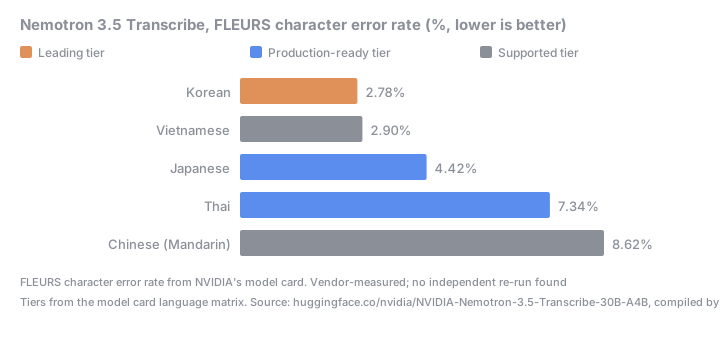
Korean's 2.78% is the lowest of the five, ahead of Japanese at 4.42% and Chinese at 8.62%. Across those three languages the tiers follow the same order: Korean is Leading, Japanese is Production-ready, and Mandarin is Supported. Across all five, though, tier and error rate diverge. Vietnamese sits in the lowest Supported tier yet scores 2.90%, better than Japanese. The tiers appear to weigh several capabilities and tests, not this one table. All of these numbers come from NVIDIA, and FLEURS is read speech. Phone calls, meetings with overlapping talkers, and regional dialects will likely score worse. At the time of writing we found no independent Korean evaluation of Nemotron 3.5 Transcribe. MindStudio's hands-on test across roughly 30 languages lists Korean among the languages tried but does not report a Korean result.
Open-weight accuracy on an independent index
The independent number available is Artificial Analysis's AA-WER. The page's summary text names Mistral's Voxtral Small and Nemotron 3.5 Transcribe as the top two open-weight models, both at 2.8%. The table on the same page, however, lists Nemotron 3.5 Transcribe hosted by DeepInfra at 3.4%. The page does not explain which conditions produce which number, so we show both. API-only models go lower. Figure 2 places this release next to Mistral's latest transcription models on the same index.
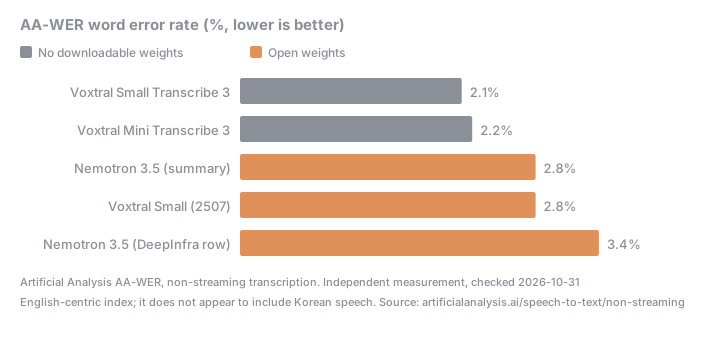
The API-only Voxtral Small Transcribe 3 scores 2.1% and Voxtral Mini Transcribe 3 scores 2.2%. Against the 2.8% summary value, choosing open weights costs 0.6 to 0.7 percentage points on this index; against the 3.4% DeepInfra table value, it costs 1.2 to 1.3 points, by our arithmetic from Figure 2. NVIDIA's blog cites the 2.8% figure and stresses that the model reaches it with about 4 billion active parameters, against 24 billion for the model it ties.
This index says little about Korean. As our earlier Voxtral 3 write-up found, AA-WER mixes voice-agent conversations, European Parliament speeches, and earnings calls, and appears to be English-centric. Nothing shows that Figure 2's ordering holds for Korean.
Word timestamps and what it takes to run
For anyone building a Korean speech product, the most visible difference is word-level timestamps. After decoding, a lightweight CTC alignment adapter maps the transcript back onto the audio and returns start and end times for each word, with speaker tags. Per the model card, you get them with timestamp capture enabled on a vLLM server or when running the model directly in Hugging Face Transformers; the SGLang-Omni integration does not include them. Mistral's Voxtral 3 file-transcription docs state "Word-level timestamps aren't available." Voxtral 3 weights are still not on Hugging Face at the time of writing, and Mistral's announcement routes self-deployment through its team. Side by side:
| Item | Nemotron 3.5 Transcribe | Voxtral Small Transcribe 3 |
|---|---|---|
| Weights | Open (OpenMDW-1.1), direct download | No download. API, or self-deploy via Mistral |
| Word timestamps | Yes | No, segment-level only |
| Live streaming | No, recorded audio only | Handled by a separate realtime model |
| Per-language Korean score | FLEURS CER 2.78% (vendor) | Not published |
| AA-WER (independent) | Summary 2.8%, DeepInfra table 3.4% | 2.1% |
The model card is blunt: "This is an offline model." It processes audio internally in 30-second chunks, but says that does not make it a real-time streaming service. A single request takes up to one hour of audio, and NVIDIA's blog says it distinguishes up to eight speakers.
Check the hardware before planning a deployment. The model has 34 billion parameters including the audio encoder, with about 4.3 billion active per token. The model card's reference deployment is a single H100 80GB. The consumer RTX 5090 is listed only for the 4-bit NVFP4 checkpoint, and the L40S 48GB only for FP8. Quantization losses have to be checked per checkpoint, as we saw with a different model in our Nemotron 3.5 Super VL post. We could not find NVFP4 scores for Transcribe in the model card.
The throughput figure needs its conditions attached. The model card says one RTX PRO 6000 Blackwell transcribes 2,238 seconds of audio per second. That result uses the optimized vLLM implementation in the Nemotron Transcribe NIM, together with NVFP4 and DFlash2 speculative decoding. The same model card says word timestamps are not available with DFlash2, so this speed and word timestamps likely cannot be had together. It also says these optimizations are not yet in the open-source release, and that the vLLM integration shipped in NeMo Speech on launch day is expected to be roughly two times slower.
Hacker News, for and against
The Hacker News thread went up on launch day and had 133 points and 26 comments when we checked on October 31, 2026. People who tried the model came away with mixed views.
The most concrete criticism came from user mewse-hn, who compared it with NVIDIA's small Parakeet transcription model and wrote "it's slower, heavier, and has a higher error rate" (source), noting they were testing a Q4 quant that might not have full accuracy. The same user said that on a full anime episode it "got confused by english words in the theme song" (source). Speech with English words mixed in is a condition Korean content can run into as well. User solarkraft called the recorded-audio-only design a "Bit unfortunate!" and added that the Nemotron Streaming model in the Handy app handles their dictation (source).
There was praise too. User AkashKaStudio pointed to the experimental near-field-speaker mode as "not available in any other OSS Speech LLM" (source). User drewbitt wrote "Voxtral 3 is probably the better product, but this is cheap!" (source).
What changes for Korean speech products
For Korean services that cannot send recordings to an outside API, this looks like an option worth shortlisting that you can download and run on your own servers right away. Counseling calls, internal meetings, and clinical notes contain personal data, and sending that audio to an overseas API appears to call for a cross-border transfer review. Because these weights are public, the model runs inside your own servers without a sales conversation. Downloadable weights, word timestamps, and a published per-language Korean score together are a combination Voxtral 3 does not offer. Features that need word timing, such as word search in lecture replays, caption editors, and dictation practice, can now be built on self-hosted infrastructure.
There are also clear gaps. Voice assistants, live captions, and in-call agent assist, where results must appear while someone is still speaking, are a poor fit. Korean meeting diarization and Korean–English mixed speech have no published numbers, so measure them on your own recordings first. The order we would follow: take a few dozen real Korean recordings from your service, write reference transcripts, then compare character error rate and speaker attribution against your current model on the same audio before switching. NVIDIA reports adapting the model on a single GPU in 0.5 to 2.3 GPU-hours per task, so fine-tuning is worth considering if the numbers fall short. That figure comes from 17 tasks NVIDIA chose.
Limitations
| Limitation | Detail |
|---|---|
| No hands-on measurement | This post cross-checks published documents and numbers; we did not run the model |
| Korean numbers are vendor-measured | FLEURS Korean CER and translation BLEU come from NVIDIA's model card; no independent Korean test found |
| Read speech | FLEURS is read sentences, unlike phone, meeting, or dialect recordings |
| Independent index is English-centric | AA-WER does not appear to include Korean speech and cannot be read as a Korean ranking |
| Two independent figures | Within the Artificial Analysis page, Nemotron 3.5 Transcribe appears at both 2.8% and 3.4%; we could not determine the conditions behind the difference |
| Quantized checkpoint scores | Model-card scores appear to be for BF16; FP8 and NVFP4 scores were not found |
| Timing | Model card, rankings, and Hacker News figures as checked on 2026-10-31 |
Sources
- NVIDIA Research, Nemotron 3.5 Transcribe project page: https://research.nvidia.com/labs/nemotron/NVIDIA-Nemotron-3.5-Transcribe/
- NVIDIA model card (Hugging Face): https://huggingface.co/nvidia/NVIDIA-Nemotron-3.5-Transcribe-30B-A4B
- NVIDIA on the Hugging Face blog, Nemotron 3.5 Transcribe and Granary v2: https://huggingface.co/blog/nvidia/nemotron-transcribe-granary
- Artificial Analysis, Speech to Text Leaderboard (non-streaming): https://artificialanalysis.ai/speech-to-text/non-streaming
- Mistral docs, file transcription: https://docs.mistral.ai/studio/audio/speech-to-text/transcribe-files
- MindStudio, Nemotron 3.5 Transcribe test: https://www.mindstudio.ai/blog/nvidia-nemotron-transcribe-30b
- Hacker News discussion: https://news.ycombinator.com/item?id=50275128