
News · · 9 min read
Mistral Large 4 Open Weights: What Changed in Three Weeks Since the Preview, and the GPUs It Takes to Run
In this post
Mistral published the weights of Mistral Large 4 (nicknamed Le Chonk) on Hugging Face on October 29, 2026. That is three weeks after the API-only preview of October 6, and the released checkpoint is an improved version trained with more reinforcement learning. On the composite index from the independent evaluator Artificial Analysis (Intelligence Index v5), it moved only one point, from 25 for the preview to 26. What did change is efficiency: the release used about 27% fewer output tokens on the same evaluation and generated about 43% faster. Mistral's post shows terminal coding rising 13 points, from 28% to 41%, but its chart labels the 28% preview score as self-reported and the 41% release score as an Artificial Analysis metric, so the two values were not measured by the same party. The FP8 weights alone exceed 1,060 GB, so an 8× H200 node is the entry point for self-hosting. For most developers, this release looks less like "a model you run at home" and more like "a model you can use through an API today and move onto your own servers later."
This article covers what changed between the preview and the release, which numbers come from Mistral and which from a third party, the hardware implied by the weight files, the license's service clause, the Hacker News debate, and what it changes for developers in Korea.
Preview versus release
The October 6 preview post promised "weights drop end of this month," and Mistral delivered on the 29th. The name is the same, but the published weights are not the model that served the preview API. The release post describes it as an improved model after "three weeks of additional reinforcement learning."
| Item | Preview (Oct 6) | Release (Oct 29) |
|---|---|---|
| Weights | Closed, API only | Published on Hugging Face |
| Reasoning modes | Included a None mode | low · medium · high (default) |
| Context window (per Artificial Analysis) | About 524,000 tokens | 1 million tokens |
| Terminal-Bench 4.0 (Mistral's post) | 28.3% (self-reported) | 41% (labeled as AA metric) |
The reasoning change matters for existing code. The release post says low replaces the old None mode, and the model card keeps high as the default while recommending medium for everyday work and low for quick chat replies. Code that called the preview without reasoning appears to need low to get the equivalent behavior; how the preview's None mode behaved exactly is not documented publicly.
Parameter counts differ by document. The Hugging Face model card says roughly 1 trillion total and 49 billion active per token (52 billion including embeddings and output layers). The Mistral API docs and Artificial Analysis list 1.05 trillion total (Artificial Analysis rounds to 1.1T) and 52 billion active. This looks like a difference in what gets counted rather than a contradiction. When we checked on October 30, though, the API docs page still showed the date as October 6 and the status as "Public Preview." The API model name is mistral-large-4; the Hugging Face repository is Mistral-Large-4-1T-A52B.
Vendor numbers and third-party numbers
The benchmark charts in the release post are values Mistral chose to show. We took the four charts that show both the preview and the release and put them on one axis.
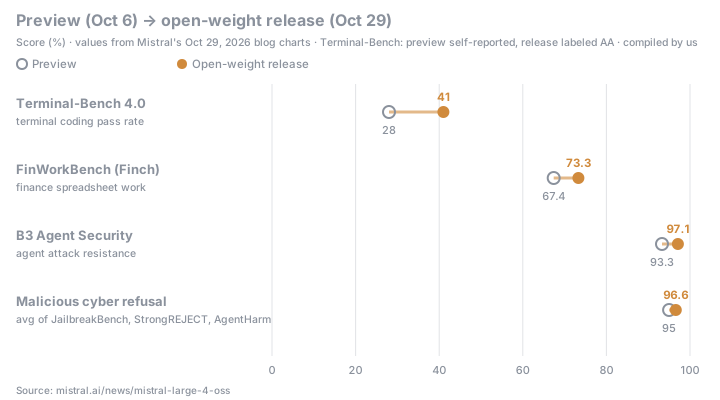
Terminal coding moved the most. Mistral reports Terminal-Bench 4.0 at 41%, 13 points above the preview, with 30% fewer output tokens. The chart, however, is titled "Artificial Analysis Coding Agent Index - Terminal-Bench 4.0," and the "self reported" label sits only on the 28% preview bar. The 13 points may be a difference between two harnesses, so it is safer to read it as a direction only. The finance spreadsheet benchmark (FinWorkBench) went from 67.4% to 73.3%, and resistance to attacks on agents (B3) went from 93.3% to 97.1%. The refusal rate on malicious cyber requests rose from 95% to 96.6%. These three carry no measurer label, and we found no third-party re-run of them yet.
For a third-party view, we used two Artificial Analysis model pages. The preview page is still online with a "deprecated" notice, which makes a side-by-side comparison possible.
| Artificial Analysis metric | Preview | Release (high) |
|---|---|---|
| Intelligence Index v5 | 25 | 26 |
| Output tokens used on the index | 150 million | 110 million |
| Output speed (tokens per second) | 112.9 | 161.3 |
The composite score barely moved. Token use and speed did: output tokens fell from 150 million to 110 million, about 27% fewer, and speed rose from 112.9 to 161.3, about 43% faster (our calculation). Fewer tokens for the same work also means a smaller API bill for that work. The preview page notes that performance benchmarking now continues only for a single default workload, so the preview's speed figure may come from a different point in time than the release's.
A score of 26 places the release 9th of 21 open-weight models in its size class on the Artificial Analysis index. The model card itself calls it "the highest among western open-weight models" and concedes that leading Chinese open-weight models score higher on this composite. Mistral's pitch is coding and cybersecurity rather than the composite. It says the model scores 48% on the Artificial Analysis Coding Agent Index, effectively tied with GLM-5.3, while using 47% fewer tokens per task on average. On the same organization's Cyber Index it scores 51%. We covered a similar vendor-versus-independent split in our Kimi K3.1 Pro article.
Memory needed to run it yourself
We measured the real size of the weights by summing the file sizes returned by the Hugging Face API. The default checkpoint is already FP8 block-quantized, and a separate NVFP4 checkpoint targets Blackwell GPUs.
| Checkpoint | Total file size | Against H200 (141 GB) |
|---|---|---|
| Default (FP8) | About 1,060.6 GB | 7.5 GPUs' worth of weights → about 67 GB left on an 8-GPU node |
| NVFP4 | About 610.1 GB | Blackwell-only, so not an H200 option |
The calculation divides the file size by the H200's 141 GB of memory (our calculation, 1 GB = 1 billion bytes). Eight GPUs give 1,128 GB, which leaves about 67 GB for the KV cache (the intermediate state that grows with context length) and runtime buffers. The model card's vLLM example also uses tensor parallelism of 8. Using the full 1-million-token context will likely not fit in that margin, and the card advises lowering the maximum context length and concurrency if memory runs short.
The NVFP4 checkpoint is about 58% the size of the default one. The model card says it has the "same performance," but that is also Mistral's claim, and the effect of NVFP4 quantization on scores has varied by model (see our Nemotron 3.5 Super VL NVFP4 article). GGUF files for llama.cpp are linked from the official card, so lower-bit builds are possible, but there are no published measurements of their quality yet.
The license's service clause
The license is the Mistral Ecosystem Open-Weight License, a modified MIT license. It allows use, modification, redistribution, fine-tuning, and commercial use, with one condition beyond keeping the copyright and permission notice (Section 1). Section 2 says that if the licensee or any affiliate operates a "Model as a Service" business, it must sign a separate commercial license with Mistral before using the model commercially.
The same text defines Model as a Service as giving a third party access to the model for inference or post-training in a way that lets that party exercise meaningful control over inputs, parameters, or training data. End-user products that embed model capabilities within specific features, and services that merely relay requests to models hosted by others, are excluded. Section 3 exempts internal use, meaning any use that does not make the model available to third parties, and use through Mistral's official products.
Applied to typical cases, the line appears to fall like this. An internal code-review bot or internal document search is internal use and needs no contract. A product feature such as a summarize button inside an app is also excluded. A cloud or GPU provider that hosts the model and sells inference APIs or fine-tuning to customers needs the separate license. This is our reading of the text, not legal advice, and the license gives no further test for "meaningful control."
The Hacker News debate
When we checked on October 30, the release post had 1,428 points and 385 comments on Hacker News (thread). The comment with the most replies was about the license.
"Calling this "open weight" is misleading." — maxloh (comment)
"It's not open weight, it's weights available as they use a modified MIT license that is not OSI." — rcr-anti (comment)
Another commenter pointed out that only half of the refusal story was published. On the 96.6% malicious-request refusal rate, 3form asked: "Where is the statistic about not refusing the non malicious requests?" (comment). The release post does say the model handles legitimate security tasks "without unnecessary refusals," but it gives no false-refusal number. The same post also says that after monitoring live traffic since the preview, Mistral sees a potential for uplift in real attacks and is modifying its guardrails.
Opinions on quality were split. crimsoneer, who runs a personal benchmark, wrote "it's...fine, but certainly not up to the best Chinese or US open weight models" (comment), and segmondy wrote "Their last 2 models were a disaster and didn't live up to their self reported evals," adding a hope that this one would be different (comment). On the other side, nunez saw value in the self-hosting option because "Almost every regulated business in the US cannot run Chinese models" (comment), and d2kx, using the Mistral API at an EU company, wrote "Mistral has been great for us as a provider" (comment).
Hardware questions came up quickly. jamesblonde said a server with four H200s and 540 GB of memory meant "I have to go to 4bit or 3bit even to serve it" (comment). That matches the calculation above: four H200s (564 GB) cannot hold the FP8 weights or even the NVFP4 weights (about 610.1 GB), and the NVFP4 build is Blackwell-only anyway.
What it changes for developers in Korea
The biggest change appears to be for organizations that cannot use Chinese-origin models for licensing or provenance reasons: they now have a trillion-parameter-class model they can host themselves. The point Hacker News raised about US regulated industries may have a parallel in Korea's financial and public sectors, but that depends on each organization's internal rules and is not something this article verified.
For individual developers and small teams, little changes right away. A model that needs at least an 8× H200-class node will mostly be used through the Mistral API ($0.70 per million input tokens, $2.10 per million output) or OpenRouter. In that case the open weights work more like insurance: the option to move the same model onto your own servers later. Code written against the preview with reasoning turned off will likely need to move to low mode.
There is no basis yet for judging Korean-language quality. The model card lists Korean (ko) among its languages and claims fluency in more than 160, but neither the release post nor the card publishes any Korean benchmark. Anyone planning a Korean-language service should run their own evaluation first.
Limitations
| Item | Detail |
|---|---|
| Vendor numbers | Figure 1 uses values from Mistral's blog charts, and the 13-point Terminal-Bench gain may compare values from different measurers. Artificial Analysis is the only third-party source we checked directly |
| Measurement timing | The Artificial Analysis preview page is deprecated, so some of its figures may be historical |
| Hardware math | A lower bound from file size only. KV cache, concurrency, and real throughput were not measured |
| Korean | No Korean benchmark has been published, so quality is not covered |
| Hands-on use | We did not call or run the model. Every number comes from public material |
| License reading | Our interpretation of the text, not legal advice |
Sources
- Mistral, "Mistral Large 4 (Le Chonk) is now open weight" (2026-10-29): https://mistral.ai/news/mistral-large-4-oss/
- Mistral, "Mistral Large 4" preview announcement (2026-10-06): https://mistral.ai/news/mistral-large-4/
- Hugging Face model card: https://huggingface.co/mistralai/Mistral-Large-4-1T-A52B
- License text: https://huggingface.co/mistralai/Mistral-Large-4-1T-A52B/blob/main/LICENSE
- Mistral API docs: https://docs.mistral.ai/models/mistral-large-4-0
- Artificial Analysis, Mistral Large 4: https://artificialanalysis.ai/models/mistral-large-4
- Artificial Analysis, Mistral Large 4 Preview: https://artificialanalysis.ai/models/mistral-large-4-preview
- NVIDIA H200 specifications: https://www.nvidia.com/en-us/data-center/h200/
- Hacker News thread: https://news.ycombinator.com/item?id=50289418