
News · · 8 min read
Google DeepMind Genie 4: What Changed from Genie 3, the Missing Numbers, and Who Can Use It
In this post
Google DeepMind announced Genie 4 on October 27, 2026. Genie is a world model: it takes text or an image and generates a scene you can move through in real time. Three things are new. Genie 4 generates sound and dialogue together with the picture, lets you rewrite a scene in plain text while it runs, and keeps a Gemini model in the loop to plan and check what happens next. Right now only trusted testers can use it. Google AI Ultra subscribers who open Project Genie today still get Genie 3; for Genie 4 they can join a waitlist. Google gave no figures for Genie 4's resolution, frame rate, or duration.
This post covers how Genie 4 compares with Genie 3, which numbers the announcement leaves out, what the Gemini models do, who can use what today, and how Hacker News reacted.
Genie 4 next to Genie 3
The changes only become clear when both models sit on the same rows. We compiled this table from the Genie 3 post (August 5, 2025), the Project Genie help page, and the Genie 4 post and model page.
| Item | Genie 3 | Genie 4 |
|---|---|---|
| First release | 2025-08-05, limited research preview for a small cohort of academics and creators | 2026-10-27, research preview for trusted testers |
| Resolution and frame rate | 720p at 24 frames per second | Not disclosed |
| Consistency | "A few minutes"; visual memory reaches back about one minute | Holds over "short sessions"; no figure |
| Audio | Not mentioned | Ambient sound, music, and dialogue generated with the world |
| Editing a running scene | "Promptable world events" for weather, objects, and characters | Text edits to weather, camera, people, and objects, adapted to the scene by Gemini |
| Gemini models involved | Not mentioned | Gemini Omni (appearance), Gemini 3.8 Flash (planning and checking) |
| Watermark | Not mentioned | SynthID on all video and audio |
Audio is the clearest break. DeepMind calls Genie 4 "our first real-time world model to generate audio natively," and says characters talk and react to user input or events in the world as they happen. Editing a scene mid-run is not new: Genie 3 had promptable world events, although they were left out of Project Genie when it launched in January 2026. What Genie 4 adds is that Gemini rewrites your prompt to fit the surrounding scene, and keeps steering the world between your inputs.
Published numbers and missing ones
The Genie 4 announcement contains no benchmarks and no spec figures. That is a step back from Genie 3, whose post gave 720p, 24 frames per second, and "a few minutes" of consistency. The limitations section of the Genie 4 model page says only that it supports "a few minutes of continuous interaction." Two Genie 4 cells in the table above are therefore empty. We also found no third-party measurement that compares the two models on the same axis.
One figure does appear in press coverage. TechCrunch wrote that Genie 4 "can maintain a consistent scene for up to two minutes, double its predecessor's limit." That number is not in the DeepMind post or on the model page, and the article does not say where it came from, so we do not treat it as a confirmed spec.
What DeepMind did publish is a list of limits. Details and object permanence can drift as a session runs longer, after several complex edits, or while you move around the scene. Complex physical interactions, real-time audio accuracy, legible text, spatial accuracy, and long-term consistency are listed as open research problems.
What the Gemini models do
Genie 4 does not run alone. According to DeepMind, Gemini Omni anchors the simulation in real-world appearance and behavior, while other Gemini models handle the reasoning that keeps it coherent.
Gemini 3.8 Flash sits inside the real-time loop. While Genie 4 renders, Gemini 3.8 Flash watches the scene, breaks a goal into steps, and checks incoming frames to verify each step worked. When the user steps in or the world shifts, it revises the plan on the spot.
A different model shows up in the robotics experiment. DeepMind describes Gemini 4 Argon splitting a user's instruction into steps and feeding them to Genie 4 as text captions, producing a scene of Apptronik's Apollo humanoid playing checkers. The TechCrunch article names only Gemini 4 Argon, in the robotics experiment. DeepMind's post assigns 3.8 Flash to real-time guidance and 4 Argon to the robotics experiment. We covered Gemini 4 Argon itself in our post on its general availability.
Who can use what today
Project Genie now lists more than 140 countries, and South Korea appears to be among them, but it runs on Genie 3, not Genie 4. Figure 1 lays out the access stages from Genie 3's first preview to the planned Genie 4 rollout, compiled from official pages.
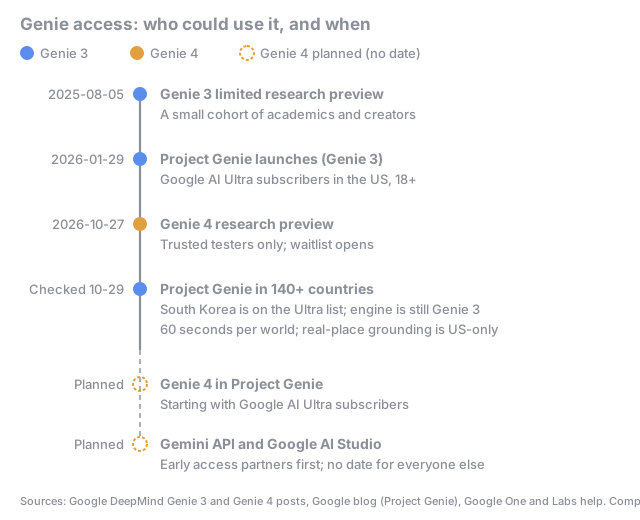
Project Genie opened on January 29, 2026, for Google AI Ultra subscribers in the US aged 18 and over. The Google One plans page, checked on October 29, says Project Genie "is available in more than 140 countries" and adds: "Only available with a Google AI Ultra plan." The Labs help page says it is offered to Ultra subscribers "where Google AI Ultra is available," and the Gemini help page's list of Ultra countries includes South Korea. Read together, these pages suggest Ultra subscribers in Korea can use Project Genie now. We did not find a separate country list for Project Genie itself.
These are the current Project Genie terms, from the Labs help page.
| Item | Detail |
|---|---|
| Engine | Genie 3 (per Google's subscription page) |
| Who | Google AI Ultra subscribers, 18+, personal Google Account (Ultra for Business excluded, per the January post) |
| Time per session | 30 seconds to create a world, 60 seconds to explore it |
| Real-place grounding | US locations only |
For Genie 4, DeepMind's pages say only that it is "coming soon" to Ultra subscribers in Project Genie and to early access partners in the Gemini API and Google AI Studio. They give no date; TechCrunch wrote "in the coming weeks." The waitlist is open, and the pages do not say whether it is limited by country.
Hacker News reaction
The DeepMind post drew 1,028 points and 582 comments on Hacker News (checked October 29). We did not classify all the comments. We picked one comment pointing out errors in the demos and one crediting the progress; even the latter wrote that "almost everyone seems not impressed at all and points at obvious errors in the samples." The quotes below are from commenters, not our view.
User inkcapmushroom on consistency in the demos:
"For several of these examples the details change if something goes out of frame and returns. A second castle is added in the dragon one. … It's very good at maintaining consistency for things that stay in frame, but I don't know that this points to it developing a strong "world simulation" like they claim." — https://news.ycombinator.com/item?id=50266032
That is the same object-permanence problem DeepMind lists in its own limitations.
User kouteiheika on missing technical details and usage limits:
"Looks cool, but it's very hard to get me excited about yet another proprietary model for which absolutely zero technical details are released (not even the number of parameters), which is safetymaxxed to the limit, and whose usage quota will (most likely) be so limited …" — https://news.ycombinator.com/item?id=50261912
On the other side, user numlock86 compared it with AI video from three years ago:
"Yes, AI gets things wrong. … To me, personally, this seems super impressive and it's clearly another leap forward. Not perfect, yes. But an improvement." — https://news.ycombinator.com/item?id=50269638
What changes for creators and developers in Korea
Not much changes right away. In countries where Ultra is offered, which appears to include Korea, a subscriber can try 60-second Genie 3 worlds today. Genie 4's audio, dialogue, and Gemini guidance loop sit behind a waitlist. Building a world from a real place is limited to US locations, so recreating, say, a Seoul side street or a local landmark from real-world imagery is not yet possible.
For developers, the API path is what matters. Genie 4 is headed to the Gemini API and Google AI Studio, but early access partners come first. A team planning to use it for game prototypes or robot training environments has no date to plan around. With no published specs, it also cannot be compared with existing engines on resolution or latency.
The structural change is the one to watch. Genie 4 ties a model that renders pixels to a Gemini model that plans, in one loop. DeepMind calls this an early step toward "hybrid world models" that combine the reasoning of code and language models with pixel-level simulation. For teams evaluating world models, the real cost is likely to depend less on the rendering model's specs and more on which model does the planning and how those calls are billed. Google has not said anything about that yet.
Limitations
| Item | Detail |
|---|---|
| Performance figures | No Genie 4 benchmarks or specs were published, and we found no third-party measurements. The comparison is limited to features |
| Hands-on use | This is a review of official documents and public reactions. We did not use Project Genie or Genie 4 ourselves |
| Korea availability | Inferred from the Ultra country list plus the "where Ultra is available" wording. We did not find a Project Genie-specific country list |
| Genie 3 blanks | "Not mentioned" means the Genie 3 announcement post does not cover it, not that we confirmed the feature is absent |
| Date | As of October 29, 2026. Once Genie 4 reaches Project Genie, Figure 1 and the Project Genie terms will change |
Sources
- Google DeepMind, Genie 4: A new generation of world simulation (2026-10-27): https://deepmind.google/blog/genie-4-a-new-generation-of-world-simulation/
- Google DeepMind, Genie 4 model page: https://deepmind.google/models/genie/
- Google DeepMind, Genie 3: A new frontier for world models (2025-08-05): https://deepmind.google/blog/genie-3-a-new-frontier-for-world-models/
- Google blog, Project Genie: Experimenting with infinite, interactive worlds (2026-01-29): https://blog.google/innovation-and-ai/models-and-research/google-deepmind/project-genie/
- Google Labs Help, Get started with Project Genie: https://support.google.com/labs/answer/16875695?hl=en
- Google One, Google AI plans: https://one.google.com/about/google-ai-plans/
- Google, Google AI Pro & Ultra subscriptions: https://gemini.google/subscriptions/
- Gemini Apps Help, Gemini Apps limits & feature availability: https://support.google.com/gemini/answer/16275805?hl=en
- TechCrunch, Google's Genie 4 world model adds audio, more realistic worlds, and real-time steering (2026-10-27): https://techcrunch.com/2026/10/27/googles-genie-4-world-model-adds-audio-more-realistic-worlds-and-real-time-steering/
- Hacker News, Genie 4: https://news.ycombinator.com/item?id=50261319