
News · · 8 min read
DeepSeek V4.1-Flash-1017: New Weights Behind an Unchanged Model Name
In this post
DeepSeek released V4.1-Flash-1017 on October 17, 2026. It is a new set of weights for V4.1-Flash, which shipped on September 10, and the API model name, deepseek-flash, did not change. Any service calling that name has been getting answers from a different model since October 17 without touching its code. All 11 benchmarks DeepSeek published went up, led by Terminal-Bench 4.0, which rose from 31.2 to 42.3. Every one of those scores was measured by DeepSeek itself. The one outside measurement we found comes from an inference provider that compared output length, and it found the model now spends 21 to 27% fewer tokens on the same math problems.
This post covers what changed under the same name, the scores lined up against the September release, output length measured by a third party, the search API that opened the same day, the pricing hours converted to Korean time, and how Hacker News split on the release.
New weights under the old name
DeepSeek's change log says "the API calling method and pricing remain unchanged." The web and app models switched to the new version the same day. The model card calls 1017 a "minor update" to V4.1-Flash. sference, an outside provider that measured it, describes the update as new weights with the same architecture, tokenizer, and prompt format. Per the September announcement, it is a 552B-parameter mixture-of-experts (MoE) model that uses 8B parameters to read input and 16B to write output. The context window is 1M tokens and the maximum output is 384K tokens.
The unchanged name is the change that matters most in practice. According to the pricing page, the model version behind deepseek-flash is now DeepSeek-V4.1-Flash-1017. Requests sent to the legacy names deepseek-v4-flash and deepseek-v4-flash-vision-exp are also served by 1017. The official pricing page lists no name for selecting the September V4.1-Flash. If you need to keep answering with the September model, self-hosting its weights from Hugging Face appears to be the only route.
The weights are on Hugging Face and ModelScope under the MIT license. The model card ships no Jinja chat template. Instead it provides a Python reference implementation of the prompt format and a Rust library, deepseek-recipe. The recommended sampling settings are temperature 1.0 and top_p 1.0.
Scores on the same axis as the previous release
The model card's table lists 1017 and the September V4.1-Flash side by side on the same 11 benchmarks. Figure 1 is our own chart of just those two columns. The upper bar is the September release, the lower bar is 1017, and the number in parentheses is the difference.
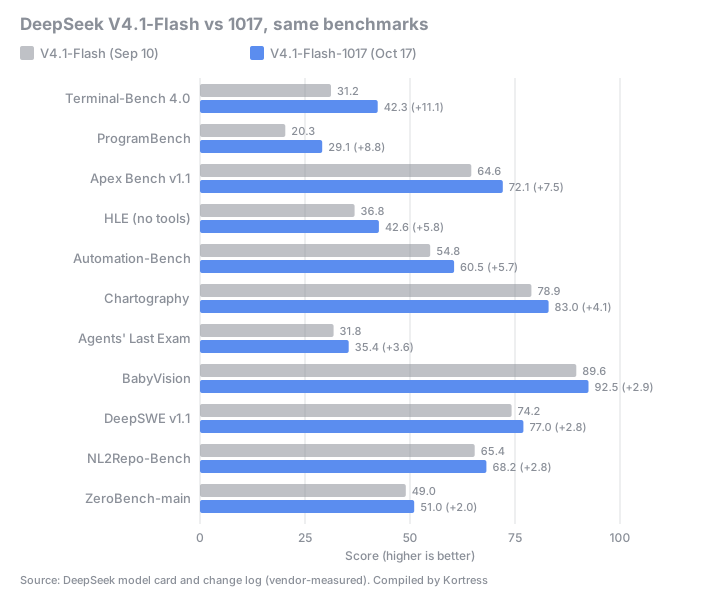
The gains concentrate in terminal work and in building programs from scratch. Terminal-Bench 4.0 rose 11.1 points and ProgramBench 8.8. Vision tasks moved less: BabyVision gained 2.9 and ZeroBench-main 2.0. Repository-level coding, DeepSWE v1.1 and NL2Repo-Bench, gained 2.8 each. Test conditions vary by benchmark. Per the model card's notes, Terminal-Bench 4.0 was run in the Claude Code harness and DeepSWE v1.1 in the Mini-SWE-V2 harness. The change log says ZeroBench-main was scored as Pass@5.
The same table includes models from other companies. Picking two of them gives this:
| Benchmark | V4.1-Flash-1017 | GPT-5.6 Sol | Claude Opus 5 |
|---|---|---|---|
| Terminal-Bench 4.0 | 42.3 | 39.9 | 51.8 |
| DeepSWE v1.1 | 77.0 | 73.0 | 74.0 |
| ProgramBench | 29.1 | 23.0 | 37.0 |
| Automation-Bench v1.0.6 | 60.5 | 45.8 | 50.3 |
The comparison models are a generation old. Anthropic released Claude Opus 5.5 on September 22 (our Opus 5.5 write-up), yet DeepSeek's table stops at Opus 5. Across all 11 benchmarks in the model card, 1017 beats Opus 5 on four: DeepSWE, Automation-Bench, Apex Bench, and Agents' Last Exam. Opus 5 still leads on the other seven: Terminal-Bench 4.0, ProgramBench, HLE (no tools), NL2Repo-Bench, and the three vision tasks. This table cannot tell you how far 1017 is from the newest models you may already be using.
Output length measured by a third party
As of October 18 we found no third-party reproduction of 1017's scores. The Decoder also wrote that independent benchmarks have not come out yet. Artificial Analysis has a page for the September V4.1-Flash but none for 1017.
Output length does have one outside measurement. On October 17, sference, a provider that serves open models, compared the old weights just before the cutover with the new weights just after, holding problems, seeds, and hardware fixed. It reported three results:
- On AIME 2024, the median response fell from 1,681 to 1,124 output tokens (21%). Correct answers went from 101 to 100 out of 120, inside the provider's measured noise floor. On the easier MATH-500 suite, tokens fell about 27%
- At the lowest reasoning setting (
reasoning_effort1), the median on hard problems fell from 1,974 to 790 tokens. The provider says the setting barely worked on the old weights - On tool calling (BFCL), both versions scored 41 out of 66
The provider is open about the small sample. Each math suite has 10 problems, so it says to read exact scores as ±1, and it notes AIME and MATH-500 are likely in training data. sference also serves this model commercially, which is worth keeping in mind. Still, it is an outside measurement pointing the same way as DeepSeek's claim of shorter outputs.
Search and Fetch APIs, opened the same day
DeepSeek also opened Search and Fetch APIs, built on its in-house search engine, to all API users. Each endpoint costs $0.75 per 1,000 successful requests; failed requests, empty search results, and timeouts are not billed. Search and Fetch called as server-side tools from DeepSeek Harness, Claude Code, and Codex are free for now; billing starts October 31, 2026, at 16:00 UTC (1 a.m. November 1 in Korea).
This lets an agent search the web without a separate contract with a search provider. DeepSeek's change log only says the engine supports multilingual search, though, and there is no data on its quality for Korean queries.
Peak pricing that overlaps the Korean workday
Pricing is the same as in September, but there is one condition teams in Korea can easily miss. DeepSeek charges by time of day, and its peak hours cover most of the Korean workday. Converting the UTC hours on the pricing page to Korean time (UTC+9) gives this:
| Korean time (Mon–Fri) | Tier | Input (cache miss) / output, per 1M tokens |
|---|---|---|
| 10:00–13:00 | Peak | $0.30 / $1.20 |
| 15:00–19:00 | Peak | $0.30 / $1.20 |
| All other hours, weekends, Chinese public holidays | Off-peak | $0.15 / $0.60 |
Peak runs 01:00–04:00 and 06:00–10:00 UTC, Monday through Friday, and off-peak rates are half of peak. Agent jobs run from an office in Korea during the day mostly pay double. Moving batch evaluations or document processing to after 19:00 Korean time halves their cost with no other change.
For and against on Hacker News
The Hacker News post linking the Hugging Face repo had passed 800 points and 600 comments when we checked on October 18. Reactions split between people who value the speed and price and people who doubt the scores.
On the speed-and-price side, user ilitirit wrote: "Opus 5.5 is still the smartest, but DS 4.1's speed and price more than make up for the 'intelligence' gap" (comment). User OsrsNeedsf2P conceded that DeepSeek does not beat Sol or Gemini on benchmarks, but said it "feels so much better" because of its response speed and visible chain of thought (comment).
The doubters went after the framing and the comparisons. User pmxi pointed out that the model card puts "minor update" and "substantial improvements" in the same sentence (comment). User sourcecodeplz wrote: "there are 100s of benchmarks. so AI labs can just pick which to show" (comment). User AmazingTurtle posted a test that gave the same C++ game-engine code review to four agents. DeepSeek V4.1 Flash took 20 minutes and found one relevant P1 issue and one irrelevant P2; GPT 6.1 Sol took 4 minutes 30 seconds and found two P1 issues and one P2 (comment). Asked which version it was, the author replied: "was the new one: 1017" (reply). That is one person's single run, and the author called it an "apples to bananas comparison."
Not all of these reactions are about 1017. ilitirit says they have used V4.1 Flash daily for "nearly a month," so most of that experience is likely with the September weights. Among the cases quoted here, only AmazingTurtle's comparison is confirmed to have run on 1017.
What teams on deepseek-flash should do
The first thing to do is check the output of anything running on deepseek-flash. Because the name did not change, nothing shows up in your deploy history, yet response length and reasoning patterns changed on October 17. Post-processing that depends on response length, features with tight token budgets, and evaluation baselines set on the September release all need to be re-measured. The official API has no name for pinning the September model, so services that need a fixed version appear better off self-hosting the weights or using a host that pins version names.
Two cost effects overlap. Shorter outputs will likely lower the bill for the same work. But because most of the Korean daytime falls in peak pricing, shifting work to off-peak hours may save more than the shorter outputs do. For agentic coding, the split several Hacker News users describe, with 1017 doing the implementation and a pricier model reviewing it, looks like the realistic choice. The comparison models are a generation old and there is no third-party reproduction, so the score table alone does not show that 1017 can replace the newest top models.
Limitations
| Item | Details |
|---|---|
| Score source | Every score in Figure 1 and the comparison table is DeepSeek's own. No third-party reproduction as of October 18 |
| Outside measurement | Only sference's. 10 problems per math suite, and the provider serves the model |
| Cost | We did not measure real billing changes after 1017. The per-task cost chart in the announcement is an image only, so we did not transcribe its figures |
| Korean | No data on Korean-language task scores or Korean search quality |
| Direct testing | This post compiles public material; we did not call the model ourselves |
| Community | Hacker News points and comment counts are as of our check and keep changing. Quoted experiences are individual observations, and some may be of the September weights rather than 1017 |
Sources
- DeepSeek, "DeepSeek-V4.1-Flash-1017: Wish-Driven Programming Made Real": https://api-docs.deepseek.com/news/news261017/
- DeepSeek API change log: https://api-docs.deepseek.com/updates
- DeepSeek Search & Fetch guide: https://api-docs.deepseek.com/guides/search
- DeepSeek models and pricing: https://api-docs.deepseek.com/quick_start/pricing
- DeepSeek, V4.1-Flash announcement (Sep 10): https://api-docs.deepseek.com/news/news260910/
- Hugging Face model card: https://huggingface.co/deepseek-ai/DeepSeek-V4.1-Flash-1017
- sference, "We Benchmarked DeepSeek's V4.1 Flash Update": https://sference.com/blog/deepseek-v41f-1017-benchmark
- The Decoder: https://the-decoder.com/deepseek-v4-1-flash-1017-beats-larger-rivals-in-agentic-tasks-while-once-again-massively-cutting-per-task-costs/
- Anthropic, Claude Opus 5.5 announcement: https://www.anthropic.com/news/claude-opus-5-5
- Hacker News discussion: https://news.ycombinator.com/item?id=50129045