
News · · 8 min read
Gemini 4 Argon Is Generally Available: What Changes When You Move Off 3.1 Pro
In this post
On October 13, 2026, Google opened Gemini 4 Argon (gemini-4-argon) to developers, enterprises, and paid subscribers. When Google first announced it on September 30, only cyber defenders in its Fairwind Program had access. For developers, the first thing to deal with is the request format, not the benchmark scores. Explicit context caching is gone, temperature, top_p, and top_k are ignored, and input, thinking, and output now share a single 1,048,576-token window. On two third-party leaderboards Argon jumps well past its predecessor, Gemini 3.1 Pro Preview, and into the top group, but its lead over second place is under two points.
This post covers the spec differences against 3.1 Pro Preview, the request changes a migration needs, the third-party results, where you can use the model, the Hacker News reaction, and what it means for teams building on Gemini.
Side by side with 3.1 Pro Preview
Google documents the two models on separate model pages. Lined up field by field:
| Item | Gemini 3.1 Pro Preview | Gemini 4 Argon |
|---|---|---|
| Model ID and status | gemini-3.1-pro-preview, Preview | gemini-4-argon, Stable |
| Token limits | 1,048,576 input / 65,536 output | 1,048,576 shared by input and output. Output defaults to 65,536, up to 1,048,576 with long decode |
| Thinking | Supported | low, medium, high; default medium |
| Context caching | Supported | Implicit only; explicit caching not supported |
| Standard price (per 1M input / output tokens) | $2 / $12 (prompts up to 200,000 tokens) | $2 / $10 through November 30; $4 / $20 from December 1 |
Table 1. Compiled by comparing the Gemini API model pages and pricing page for both models (checked 2026-10-14)
The token limit is the biggest structural change. 3.1 Pro Preview had separate input and output limits. Argon puts input, thinking, and output in one 1,048,576-token budget, so the more you feed it, the less room the answer has. By our own arithmetic, a 900,000-token input leaves 148,576 tokens for thinking and output combined.
The output ceiling, on the other hand, is much higher. Once a response goes past the default output limit, the model keeps generating one hop at a time; the docs describe each hop as "up to 64K tokens" and call this long decode. With background execution (background: true) and max_output_tokens set above 65,536, the server chains the hops for you. If you leave max_output_tokens unset, a background request still stops after the first hop.
Request changes for a migration
Google's migration checklist has five items that existing 3.1 Pro code can't leave as is.
- Remove explicit caching. Requests that create or reference caches through
cachedContents/caches.createhave to go. Implicit caching is on by default for prompts of at least 4,096 tokens and takes 95% off cached input. - Remove sampling parameters.
temperature,top_p, andtop_kare ignored if you send them. - Revisit
max_output_tokens. Apps that set it below 32,768 should raise it to at least 32,768, because Argon spends more of the limit on thinking. To use fewer tokens, Google says to lower the thinking level rather than the limit. - Raise client timeouts. Hard prompts can run for several minutes, so set HTTP timeouts to at least 15 minutes or use background execution.
- Keep conversation state on the server. Multi-turn and function-calling conversations should chain with
previous_interaction_id.
Applied to a generation config, the checklist looks like this. We wrote the example ourselves from the checklist; the fields in a real app will differ.
 generation_config = {
-    "temperature": 0,
-    "top_p": 0.9,
-    "max_output_tokens": 8192,
+    "max_output_tokens": 32768,
+    "thinking_level": "medium",
 }
-cached_content = "cachedContents/..."
The line to watch is the deleted temperature: 0. Classification or extraction code that relied on it for repeatable output loses that control, so output variance has to be measured again after the switch.
Where third parties place it
Benchmarks are only useful if you know who ran them. The chart below keeps only numbers measured by two organizations other than Google.
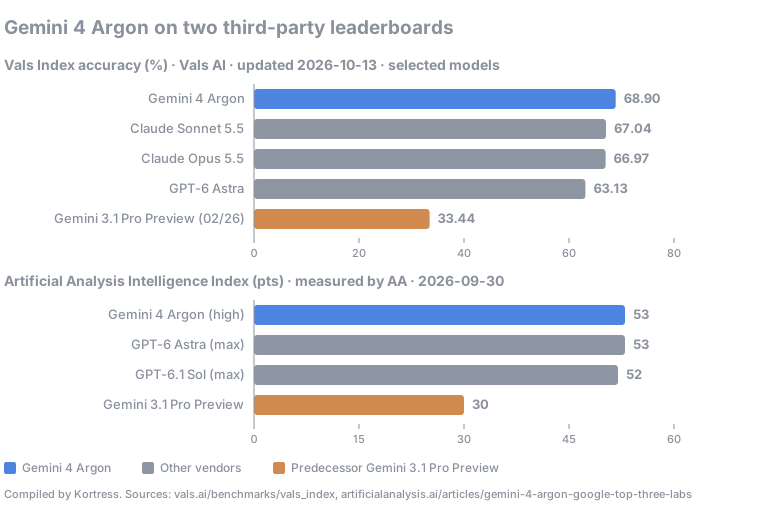
On Vals AI's Vals Index, which spans finance, coding, legal, and tax work, Argon is first at 68.90%. Its lead is small: 1.86 points over Claude Sonnet 5.5 (67.04%) and 1.93 points over Claude Opus 5.5 (66.97%). On the same board, the predecessor Gemini 3.1 Pro Preview (February 26 version) sits at 33.44%.
In its September 30 analysis, Artificial Analysis gave Argon (high) 53 on its Intelligence Index, tied with GPT-6 Astra (max) and 23 points above 3.1 Pro Preview (30). The standout number there is hallucination. On AA-Omniscience, Argon's hallucination rate is 15%, against 51% for GPT-6 Astra (max). Its accuracy, though, is 50%, five points below 3.1 Pro Preview. In other words, Argon is more willing to say it doesn't know than to guess.
Agentic results depend on the evaluation. Artificial Analysis puts Argon first on AutomationBench-AA, a workflow-automation benchmark, at 78%, but at 57% on Terminal Bench 4, behind Claude Sonnet 5.5 (max, 64%), Claude Opus 5.5 (max, 60%), and GPT-6 Astra (59%). Argon also uses a lot of tokens: an average of 62,000 output tokens per Intelligence Index task, more than twice the 27,000 used by GPT-6 Astra (max). Lower token prices still bring the cost per task for Argon (high) to $1.99 at the discounted rate, 60% of GPT-6 Astra (max) at $3.26. Once the discount ends, that rises to $3.98, about 1.2 times GPT-6 Astra (max).
Google's own figures are a different category. ERQA at 87% for physical and spatial reasoning relying on pure reasoning alone, and a 0.7% attack success rate across 15 adaptive attempts on Gray Swan's indirect prompt injection benchmark, are numbers from Google's announcement. Google's methodology page says Gemini scores were run at the highest thinking setting unless noted otherwise.
Access and requirements
Google says Argon is rolling out globally starting October 13. By channel:
| Who | Where | Requirement |
|---|---|---|
| Developers | Gemini API, Google AI Studio, Android Studio | Paid API tier; no free tier |
| Developers | Google Antigravity | Google AI Ultra subscription |
| Enterprises | Gemini for business, the API, Google Antigravity | No separate condition stated in the blog |
| Consumers | Gemini app, AI Mode in Search | Google AI Pro or Ultra subscription |
| GitHub Copilot users | VS Code, Visual Studio, JetBrains IDEs, Xcode, Eclipse, Copilot CLI, and more | Copilot Pro+, Max, Business, or Enterprise; gradual rollout |
Table 2. Compiled from Google's launch blog, the Gemini API pricing page, and the GitHub Changelog
One pair of statements is easy to misread. The Gemini API pricing page says "Gemini 4 Argon is not available on the Free tier or on the Google AI Pro plan," while the launch blog says Google AI Pro subscribers can use it in the Gemini app and AI Mode in Search. The first appears to refer to API and AI Studio plans and the second to the consumer apps. Read together, a Pro subscription alone doesn't seem to let you call Argon from AI Studio.
The Hacker News split
These reactions come from the Hacker News thread on the September 30 announcement. At the time of writing we didn't find a separate thread collecting reactions to the October 13 general availability.
On the positive side, an early-access user and a commenter focused on hallucinations:
"I had access to this over few weeks, and in my impression this was the first Gemini model that I can offload complex tasks that I don't want to do myself…" — summerlight, Hacker News
"Beats frontier models by a good margin at 15%…" — rcr-anti, Hacker News
The second comment refers to Artificial Analysis's 15% hallucination rate.
On the critical side, commenters pointed to pricing and to how Google presents benchmarks:
"So, they are basically offering opus 5.5 pricing." — GodelNumbering, Hacker News
"If you look at their methodology, they only present the model's performance at the Max reasoning levels." — robertbarbe, Hacker News
The first commenter argued that even the discounted price only matches competitors, with a higher cost per task. The second argued that maximum-thinking results say little about the settings people actually run.
What changes for teams on Gemini
For teams on 3.1 Pro Preview, this isn't a model-ID swap. Code that uses explicit caching or temperature needs changes, and output variance has to be re-measured. If you cache a long document and then fire different questions at it, it seems natural to restructure around implicit caching, which applies automatically to prompts of 4,096 tokens or more, by keeping the front of the prompt fixed. For more on thinking levels, see our earlier piece on Gemini Structured Outputs and thinking levels.
Solo developers face a new entry cost. With no free tier, trying Argon through the API means attaching paid billing first. On the subscription side, Google AI Pro covers the Gemini app, but Antigravity needs Ultra.
Cost decisions should be split around November 30. Prices double on December 1, and Argon uses more than twice as many output tokens per task as GPT-6 Astra (max). Artificial Analysis's own math has its cost per task flipping from 60% of Astra (max) during the discount to about 1.2 times after it. Whether it still looks cheap after the discount likely depends on running your own workload at low, medium, and high. Google's docs recommend evaluating all three and picking the lowest level that meets your quality bar. If you're comparing it with Claude Opus 5.5, actual bills for the same task look like a better yardstick than per-token prices.
Limitations
| Limitation | Details |
|---|---|
| No direct calls | We wrote this without an API key and did not measure output quality, latency, or billing. Every number comes from public documentation or third-party leaderboards |
| Measurement timing | Artificial Analysis published its analysis on September 30, before general availability. The Vals Index score for 3.1 Pro Preview is for the February 26 version |
| Vendor numbers | ERQA 87% and the 0.7% indirect prompt injection rate come from Google's announcement; we found no third-party re-measurement |
| Non-English performance | We found no third-party benchmark that isolates non-English, including Korean, performance |
| Community sample | We quote four comments from the September 30 Hacker News thread. We found no post-launch thread or substantial Reddit discussion |
| Code example | The diff above is our own example based on the official checklist. We did not run it against a real app |
Sources
- Google blog, Gemini 4 Argon: Built to solve your hardest problems (2026-10-13)
- Google blog, Gemini 4 Argon: our next era of frontier intelligence (2026-09-30)
- Gemini API docs: Gemini 4 Argon model page, What's new in Gemini 4 Argon, Pricing, Gemini 3.1 Pro Preview model page
- Google DeepMind, Gemini 4 Argon evaluation methodology
- GitHub Changelog, Gemini 4 Argon in GitHub Copilot
- Vals AI, Vals Index
- Artificial Analysis, Gemini 4 Argon: Google is back as one of the top three labs in intelligence achieved