
News · · 8 min read
Nemotron 3.5 Super VL: What Holds Up, and What Drops, in the Single-GPU NVFP4 Build
In this post
NVIDIA released Nemotron 3.5 Super VL, an open-weight multimodal model, on October 15, 2026. It is a mixture-of-experts (MoE) model with 120 billion total parameters, of which 12 billion are active per token. It takes text, images, documents, and video and answers in text. The weights come in two builds: full-precision BF16 and a 4-bit NVFP4 build that fits on a single H200 or one DGX Spark. NVIDIA published scores for both builds measured under the same settings, and working through that table shows that 30 of the 38 directly comparable benchmarks move by 1 point or less. The three large drops are web-browsing agents (WebVoyager, −11.41), long software tasks (DeepSWE, −6.45), and multilingual knowledge (MMLU-ProX, −3.15).
This post covers what shipped, the gap between the two builds, how the model compares with its teacher Nemotron 3 Ultra, what outside measurements and early reactions say, and what to check before using it in languages other than English.
What shipped and where it runs
Nemotron 3.5 Super VL puts reasoning, instruction following, tool calling, and visual understanding into one model. NVIDIA's pitch is that teams no longer need to run a separate text model and vision-language model and pass context between them. The architecture interleaves Mamba-2, MoE, and attention layers and adds a C-RADIO vision encoder. Context goes up to 1 million tokens, and video input is limited to MP4 clips of up to two minutes.
The model is distilled from Nemotron 3 Ultra. According to the model card, it starts from Nemotron 3 Super Base, receives 1 trillion tokens of distillation from Ultra Base, and then gets additional training on Indic-language data and, separately, on 67 billion tokens of software-engineering data. It is released under the OpenMDW-1.1 license, and the model card says it is ready for commercial and non-commercial use. Weights are on Hugging Face and ModelScope, and hosted access is available through OpenRouter and NVIDIA NIM.
The NVFP4 model card lists these recommended vLLM configurations:
| Hardware | Runtime | Inputs | Context |
|---|---|---|---|
| 1× DGX Spark | vLLM | Text, image | 1M tokens |
| 2× H100 | vLLM | Text, image, video | 1M tokens |
| 1× H200 | vLLM | Text, image, video | 1M tokens |
| 1× GB200 | vLLM | Text, image, video | 1M tokens |
The DGX Spark configuration leaves out video. The only configurations in the model card that include video are 2× H100, 1× H200, and 1× GB200. A team that wanted to run video analysis on a single desktop box would be testing outside the officially recommended setups. The BF16 build is listed for 4× H100 or 2× GB200, and NVIDIA positions it for customization and full-precision evaluation.
NVFP4 versus BF16
Fitting on one GPU requires the NVFP4 build, so that is likely the build most deployments will use. The NVFP4 model card includes a table comparing both builds with the same configs and harnesses. We computed the difference for each row. Figure 1 shows the largest movers plus a set of representative rows.
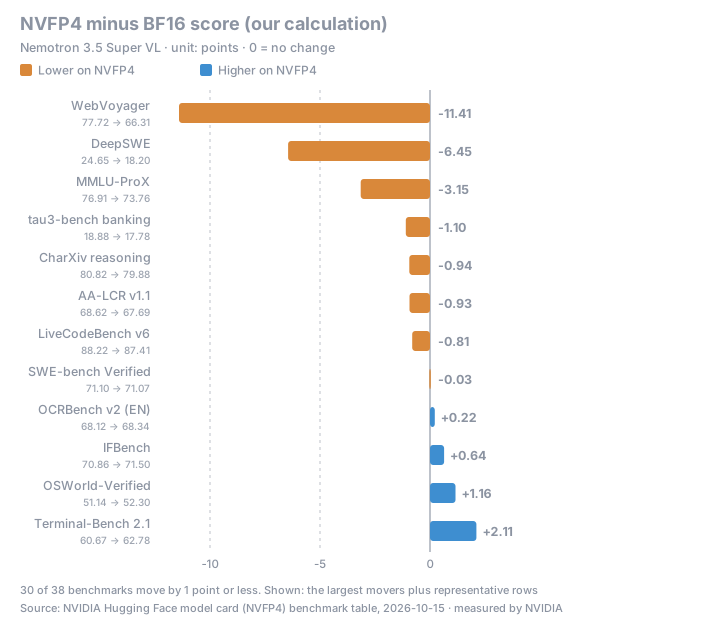
For most benchmarks, the quantization loss is within noise. SWE-bench Verified goes from 71.10 to 71.07, and Terminal-Bench 2.1 actually rises from 60.67 to 62.78. NVIDIA attributes this to quantization-aware distillation (QAD), where the 4-bit model is trained to match the BF16 model's outputs to close the precision gap.
The three drops are of different kinds. WebVoyager falls from 77.72 to 66.31 and DeepSWE from 24.65 to 18.20. Both are long, multistep agent tasks. Small errors that compound over many steps may explain the larger loss, but NVIDIA does not give a reason. The third, MMLU-ProX, is a multilingual knowledge test that, in its original paper, asks the same questions in 29 languages, Korean among them. NVIDIA's model card does not say which language set it used. It drops from 76.91 to 73.76, which is the largest decline outside those two agent benchmarks.
All of these numbers were measured by NVIDIA. The table gives no sample counts or run counts, so differences under 1 point are best read as direction only.
Where it beats its teacher, and where it does not
A distilled model is easy to dismiss as a smaller copy of its teacher. The BF16 model card's comparison table shows Nemotron 3.5 Super VL ahead of Nemotron 3 Ultra on several tasks. Below are the two models' values from that table, all measured by NVIDIA.
| Benchmark | Nemotron 3 Ultra | Nemotron 3.5 Super VL (BF16) |
|---|---|---|
| BrowseComp | 67.85 | 78.00 |
| Terminal-Bench 2.1 | 54.80 | 60.67 |
| GPQA-Diamond | 87.00 | 89.52 |
| SWE-bench Verified | 73.90 | 71.10 |
| AA-LCR v1.1 (long context) | 75.20 | 68.62 |
| MMLU-ProX (multilingual) | 83.10 | 76.91 |
| tau2-bench telecom | 83.00 | 73.19 |
| IFBench (instruction following) | 82.90 | 70.86 |
Super VL leads Ultra on web research and terminal tasks. NVIDIA's blog also reports it ahead on Hermes Bench (63.44% vs 56.33%) and LangChain behavioral evals (87.05% vs 84.3%). It trails Ultra by 12.04 points on instruction following, 6.19 on multilingual knowledge, and 6.58 on long-context reasoning.
Other open models in the same table put this in perspective. Qwen3.8-Flash-Next scores 78.7 on SWE-bench Verified and 85.80 on Terminal-Bench 2.1, and is ahead of Super VL on most agent benchmarks. On accuracy alone, Super VL is not the top model in its size class. NVIDIA's argument is throughput: its blog claims up to 5x higher agentic throughput on a single GPU than other open models in the same size category.
Measurements from outside NVIDIA
Artificial Analysis gives Super VL a score of 26 on its Intelligence Index, against a median of 8 for the models it groups as comparable. On the overall leaderboard, however, an NVIDIA chart quoted by The Decoder shows a wide gap to the leading closed models; the top score in that chart is 58.
Speed numbers depend heavily on how they are measured. NVIDIA's blog cites more than 600 tokens per second on a Baseten endpoint. The Artificial Analysis model page lists an output speed of 196.3 tokens per second. The two numbers come from different providers and conditions, so they are not directly comparable. Still, the 5x throughput claim is NVIDIA's own, and we did not find a third-party reproduction under the same conditions. Artificial Analysis also notes that the model generated 170 million output tokens during its Index evaluation, against a median of 100 million. Fast generation buys less end-to-end time when a model writes more tokens.
NVIDIA's blog says EXO Labs ran an independent evaluation on DGX Spark and placed Super VL on the Pareto frontier for accuracy and task completion time. We could not review that evaluation directly.
Early reactions on Hacker News and in the press
Reaction on Hacker News has been thin. The launch-day thread for the Hugging Face model card had two comments at the time of writing. One user, techsystems, singled out the speed techniques.
"LiLiCorr spec decode + Mamba blocks seem really interesting for the speed up." — techsystems, Hacker News
Another, scirob, pointed out that NVIDIA's own table places it behind a competitor.
"this 3.5 Super is still below Qwen 3.8 next as they state themsleves" — scirob, Hacker News
The Decoder wrote that publishing datasets and training recipes makes Super VL "more open than many open-weight models, which typically only share the weights." The same article called the strategy self-serving: the more companies run their own open models, the more compute they buy, and every variant is tuned for NVIDIA hardware. We found no substantive Reddit discussion at the time of writing.
What to check before using it in Korean or other non-English languages
Language coverage is the first thing to check. Both model cards list six languages: English, Spanish, French, German, Italian, and Japanese. Korean is not among them. Korean was one of 15 languages extracted from Common Crawl for pretraining, but NVIDIA has not published any Korean-specific results. OCRBench v2 is reported only for English (68.12) and Chinese (59.15). The additional language training went to Indic languages.
Teams building document agents that read Korean receipts, contracts, or reports should therefore test with their own documents first. The NVFP4 build that fits on one GPU scores 3.15 points lower than BF16 on MMLU-ProX, whose original 29-language set includes Korean, and BF16 is already 6.19 points below Ultra. Where Korean quality matters, it seems safer to run the same inputs through both builds rather than draw conclusions from NVFP4 alone.
The model looks best suited to organizations that cannot send data outside. For finance, public-sector, or healthcare teams that cannot pass documents to an external API, commercially licensed weights that run image and document understanding on a single H200 in-house are a meaningful option. NVIDIA also released training recipes and open datasets, which opens a path to further training on Korean documents. The model card also lists undisclosed training data, so not all of the training data is public. No one has yet published how much that helps.
Limitations
| Limitation | Detail |
|---|---|
| No hands-on run | We did not download or run the model. Every score in Figure 1 and the tables is taken from, or calculated from, NVIDIA's model card tables |
| Vendor measurements | The build comparison, teacher comparison, 5x throughput, and Hermes Bench and LangChain scores are all NVIDIA's numbers. We found no third-party reproduction under the same conditions |
| Benchmark count | "30 of 38" counts only rows where both the BF16 and NVFP4 columns are single numbers. It excludes GDPval-AA (an Elo scale), the duplicate BrowseComp [offline] row, and rows with several values in one cell |
| Korean performance | We found no Korean-only benchmark from NVIDIA or third parties. MMLU-ProX covers 29 languages in its original paper, and neither the model card nor the blog states which language set NVIDIA ran. We did not review the technical report |
| Speed figures | NVIDIA's 600+ tokens per second and Artificial Analysis's 196.3 tokens per second come from different providers and conditions and should not be compared |
| Community sample | As of October 16, 2026, only two Hacker News comments, so the reaction is not representative |
Sources
- NVIDIA Technical Blog, NVIDIA Nemotron 3.5 Super VL Powers Specialized Agents with Multimodal Reasoning (2026-10-15)
- Hugging Face model card, NVIDIA-Nemotron-3.5-Super-VL-120B-A12B-BF16
- Hugging Face model card, NVIDIA-Nemotron-3.5-Super-VL-120B-A12B-NVFP4
- Artificial Analysis, Nemotron 3.5 Super VL model page
- The Decoder, Nvidia's Nemotron 3.5 Super VL is an open model built to run enterprise AI agents nonstop (2026-10-15)
- arXiv, MMLU-ProX: A Multilingual Benchmark for Advanced Large Language Model Evaluation
- Hacker News, Nvidia Nemotron 3.5 Super VL 120B A12B