
News · · 8 min read
Meta Muse Spark Open: Measured Mac Studio Speeds and How the License Differs from Llama 4
In this post
Meta released the weights for Muse Spark Open on October 15, 2026. It is a mixture-of-experts (MoE) model with 816 billion total parameters, 42 billion of them active per token, and a 1-million-token context window. It takes text, images, video, and audio, and answers in text. On the same day Apple published measurements of the model running across several M5 Ultra Mac Studios. Four linked machines generate 36.73 tokens per second at an 8,192-token context. At a 65,536-token context, though, the first token takes 40.6 seconds to arrive. The license drops the Llama 4 trigger of 700 million monthly active users. In its place is a new one: offering the model as an API business while you and your affiliates exceed $20 million in annual gross revenue. The license also says the model is not intended for people under 18.
This article covers the three ways to run the model, measured speeds on linked Mac Studios, how the license differs from Llama 4, who measured the published scores, the Hacker News reaction, and what Korean teams should weigh.
Three ways to run it
From Meta's announcement and the Hugging Face model card, the options are:
| Path | Where | What you need |
|---|---|---|
| Hosted API | Baseten, Fireworks AI, Groq, Modal, Nebius, OpenRouter, Together AI | An account with the provider |
| Your own GPUs | Hugging Face, Amazon SageMaker AI, Google Cloud Model Garden, Microsoft Foundry | At least 700GB of VRAM for NVFP4, 2TB for BF16 |
| Linked Mac Studios | Apple MLX | Two or more M5 Ultra Mac Studios over Thunderbolt 5 |
Downloading the weights has one more hurdle. The Hugging Face repository is gated with manual approval. You submit your legal name, date of birth, country, and affiliation, and accept the license before you can download. For self-hosting, Meta lists SGLang, vLLM, TensorRT-LLM, Hugging Face Transformers, Apple MLX, llama.cpp, and Unsloth as supported engines.
The model does not fit on one machine. Apple notes that the BF16 original needs more than 1.6TB for the parameters alone. The 4-bit NVFP4 version still takes about 493GB. Add the memory used for intermediate computation, and a single 512GB Mac Studio falls short. We looked at how much NVFP4 costs in benchmark scores for a different model in our Nemotron 3.5 Super VL article. For Muse Spark Open, there is no published side-by-side of the NVFP4 and BF16 versions yet.
Measured speed on linked Mac Studios
Figure 1 redraws the Muse Spark Open rows from Apple Machine Learning Research's table, measured with mlx_lm.benchmark. Apple ran the NVFP4 version on M5 Ultra Mac Studios, generating 128 tokens after the context.
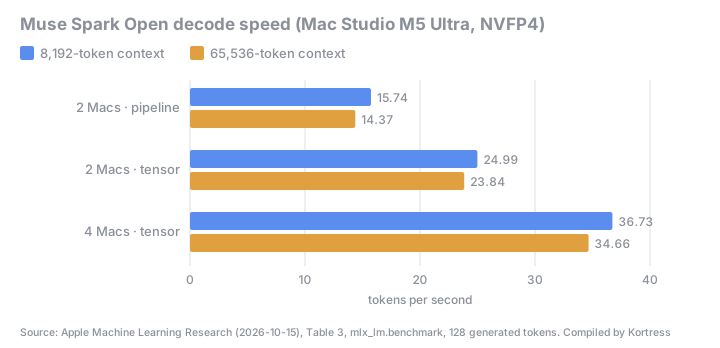
Decode speed barely drops as the context grows. With four machines in tensor parallel it goes from 36.73 at 8,192 tokens to 34.66 at 65,536. The real gap is in time to first token (TTFT). From the same post:
| Setup | TTFT, 8,192 context | TTFT, 65,536 context |
|---|---|---|
| 2 Macs · pipeline parallel | 8.4 s | 47.6 s |
| 2 Macs · tensor parallel | 8.2 s | 70.3 s |
| 4 Macs · tensor parallel | 4.8 s | 40.6 s |
At long contexts, two machines in tensor parallel are slower than two in pipeline parallel. Apple attributes this to the separate normalization of the experts' outputs, which adds communication during prefill. It adds that the cost is recovered at four machines. Cabling matters too. With one Thunderbolt cable per link, the four-machine setup took about 50.5 seconds to first token at 65,536 tokens; two cables brought it to 40.6. All of this depends on the Thunderbolt RDMA driver in macOS 26.2 and MLX v0.30.1 or later.
There is a hosted-API number for reference. Artificial Analysis measures 131 output tokens per second, the median across API providers (checked October 17, 2026). The method and hardware differ, so it does not belong on the same axis as Figure 1.
What changed from the Llama 4 license
Muse Spark Open ships under a new Muse Model License, not a Llama-style Community License. We compared the two texts clause by clause:
| Clause | Muse Model License | Llama 4 Community License |
|---|---|---|
| When you need a separate deal with Meta | You offer the model to third parties via API or similar (Model as a Service) and you and your affiliates exceed $20 million gross revenue in 12 months | Over 700 million monthly active users in the month before the release date |
| Attribution | "Built with Muse Spark Open" in the product UI, documentation, website, or settings menu | "Built with Llama" on a related website, UI, blog post, about page, or documentation |
| Derived model names | No requirement | Must start with "Llama" |
| Age | Not intended for people under 18 (Usage Policy) | No such clause in the license or use policy |
The biggest change is that the trigger moved from audience size to business model. Section 3 says the $20 million clause does not apply to internal use, research, or using the model to power features of your own product. The ones it catches are cloud and inference companies that resell the model as an API. Attribution, on the other hand, now reaches further. The license defines Derivatives to include models trained on this model's outputs. Generate synthetic data with Muse Spark Open, train your own model on it, and you still owe the "Built with Muse Spark Open" notice.
Published scores and who measured them
The model card compares Muse Spark Open with seven open-weight models of similar size. We picked the two with the highest Intelligence Index, GLM 5.3 and Kimi K3, and the rows that show the strengths and weaknesses:
| Benchmark | Muse Spark Open | GLM 5.3 | Kimi K3 |
|---|---|---|---|
| Artificial Analysis Intelligence Index | 39 | 45 | 44 |
| Terminal-Bench 2.1 | 76.4 | 83.9 | 85.0 |
| DeepSWE 1.1 | 60 | 67 | 68 |
| MCP-Atlas | 89.2 | 84.2 | 82.3 |
| HLE-Diamond (no tools) | 26.1 | 16.4 | 22.2 |
| AA Omniscience | 25 | 14 | 20 |
It trails both on the overall index and on the coding-agent rows. It leads on knowledge reliability (AA Omniscience) and tool use (MCP-Atlas). Meta pitches the model as built for coding and agentic work. The coding numbers back that pitch the least.
Meta's evaluation methodology document lists the source of each number. The Intelligence Index, Terminal-Bench 2.1, and AA Omniscience come from Artificial Analysis. MCP-Atlas and HLE-Diamond come from Scale AI. On DeepSWE, only the Muse Spark Open figure comes from Artificial Analysis. The GLM 5.3 and Kimi K3 figures are those companies' own reports, run on different harnesses. The score of 39 also appears on Artificial Analysis's own model page. The same page calls the model "particularly expensive" next to open-weight models of similar size, at $1.25 per million input tokens and $4.25 per million output tokens.
What Hacker News pointed out
Apple's post drew more than 300 points and 158 comments on Hacker News (checked October 17, 2026). Most of the criticism targeted the test conditions. User peri-cl wrote that Apple was "benchmarking Meta's model at 4-bit, against Qwen only at native BF16," which tilts the comparison. User mrboatshoepants noted the first chart uses an 8,192-token context: "Thats not nearly enough context to be useful these days." Apple's post does include 65,536-token tables, though; the 40.6 seconds above comes from one of them.
Others were more hopeful. User pdp granted that a Mac Studio "costs more than the subsidised subscription," but added that "the promise that one day we can run these models on commodity hardware is exciting." User comandillos was blunt: "A 800B model that performs way worse than other 300B ones."
What to weigh in Korea
For most Korean teams, the hosted API looks like the practical route. On four linked Mac Studios, a long context still means more than 40 seconds before the first token. A coding agent that loads a whole repository into context would pay that wait on every request. The Mac Studio route makes sense for teams that cannot send source code or customer data to an outside API. It gives them a second way to run a frontier-class open-weight model on their own network, besides GPU servers.
Two license points come first. One is education and community services with teenage users. The Usage Policy says the model is not intended for people under 18. The model card makes risk assessment and legal compliance in such deployments the deployer's job. The other is Korean cloud or inference providers that would list the model as an API product. The $20 million clause applies to them directly. A startup that only uses the model inside its own app appears to owe mainly the "Built with Muse Spark Open" notice and compliance with the Usage Policy, whatever its revenue.
Korean quality needs its own testing. The model card says only that the model was "trained on data from more than 100 languages" and does not name its strongly supported languages. It also warns that "performance may degrade on languages outside the strongly supported set."
Limitations
- We did not download or call the model. Speeds are Apple's measurements. Scores are restated or reorganized from Meta's model card and Artificial Analysis.
- The Mac Studio speeds were measured by Apple, which promoted running this model on Mac Studio the same day. We found no third-party reproduction.
- Apple's tables use batch size 1 and 128 generated tokens. They say nothing about throughput on a server with many concurrent users.
- In the benchmark table, scores come from different sources (Artificial Analysis, Scale AI, vendor self-reports), and some rows, such as DeepSWE, use a different harness for each model. The full evaluation report Meta promised has not been published.
- The license comparison is our reading of the texts, not legal advice. Check the original texts with counsel before making contract decisions.
- We found no Korean-language evaluation from Meta or any third party.
Sources
- Meta AI Research, Introducing Muse Spark Open, The Most Capable US Open-Weight Model to Date (2026-10-15)
- Hugging Face model card, meta-models/Muse-Spark-Open-816B-A42B
- Meta, Muse Spark Open Evaluation Methodology (PDF, 2026-10)
- Apple Machine Learning Research, Local and Distributed Large LLM Inference with MLX and RDMA on Mac Studio (2026-10-15)
- Meta, Llama 4 Community License Agreement
- Artificial Analysis, Muse Spark Open (xhigh) model page
- Hacker News, Apple ML Research: Muse Spark Open with MLX on Mac Studio