
News · · 8 min read
Mistral Voxtral 3: Better Transcription, but No Word Timestamps and No Open Weights
In this post
Mistral released Voxtral 3 on October 20, 2026. It is a family rather than one model: three transcription models, one text-to-speech model, and a voice agent SDK built on LiveKit. The accuracy gain holds up under third-party measurement. On Artificial Analysis's word error rate index (AA-WER v2), Voxtral Mini Transcribe 2 scored 3.6% and its successor, Voxtral Mini Transcribe 3, scores 2.2%. Existing Voxtral 2 users should look at two other changes first, though. File transcription no longer returns word-level timestamps, and the Voxtral 3 weights are not on Hugging Face. Korean appears in the benchmark language lists for the three transcription models and in the preset voice list for speech synthesis, but Mistral has not published a Korean-only score, and we could not find a third-party one at the time of writing.
This article covers what each model does and how far its Korean support goes, the generational gap on a third-party index, the latency-versus-accuracy trade-off in realtime transcription, the breaking changes, the numbers that disagree across Mistral's own pages, and the reaction on Hacker News.
The four models and their Korean coverage
The model pages list all four models as Public Preview, dated October 20, 2026. The API is served from Mistral's European, US, and global endpoints. Here is the lineup, compiled from Mistral's documentation.
| Model ID | Role | Languages | Korean |
|---|---|---|---|
voxtral-small-transcribe-3-0 | File transcription, most accurate | 50 | Not listed by name; in the FLEURS eval set |
voxtral-mini-transcribe-3-0 | File transcription, 4B parameters | 50 | Not listed by name; in the FLEURS eval set |
voxtral-mini-transcribe-realtime-3-0 | Realtime transcription | 45 languages and dialects | In the realtime FLEURS eval set |
voxtral-mini-tts-3-0 | Text to speech | 35, plus 50+ dialects | 2 preset voices |
The docs do not name the 50 file-transcription languages, so the evidence for Korean is the evaluation list, and being on a list is not the same as being good at it. The multilingual chart in Mistral's announcement reports a single average across 45 FLEURS languages. Korean is one of them, scored by character error rate (CER) instead of word error rate, but Mistral does not break the average down by language. For a Korean product, the average is all there is to go on.
The voice agent SDK chains realtime transcription, a reasoning LLM, and speech synthesis into one streaming pipeline. Mistral says no stage waits for the previous one, so each conversational turn completes in under a second. That figure is Mistral's own; no independent measurement exists yet.
The generational gap on a third-party index
In Mistral's own chart, Voxtral Small Transcribe 3 averages 4.0–4.1% across 45 FLEURS languages, against 14.9–16.0% for Whisper large-v3. Vendor-chosen comparisons only go so far, so we lined up the earlier Voxtral models against the new ones on Artificial Analysis's non-streaming index, where every model is measured the same way.
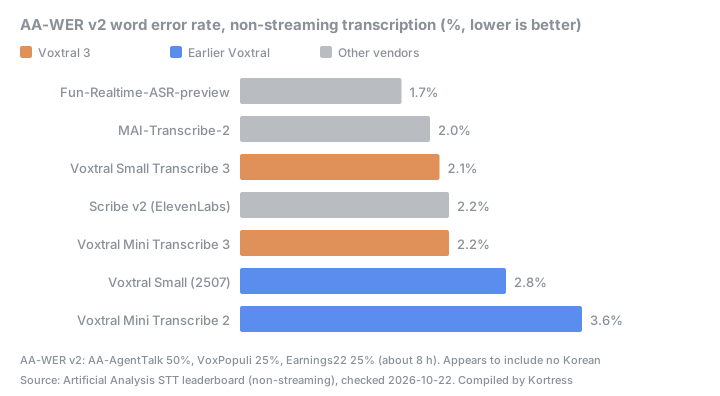
The Mini tier improved the most, from 3.6% (Mini Transcribe 2) to 2.2% (Mini Transcribe 3). The larger tier went from 2.8% for Voxtral Small (2507) to 2.1% for Voxtral Small Transcribe 3. On the leaderboard, Small Transcribe 3 ranks third and Mini Transcribe 3 fifth. First place is Fun-Realtime-ASR-preview at 1.7%.
This index appears to contain no Korean. AA-WER v2 is about eight hours of audio weighted 50% AA-AgentTalk, 25% VoxPopuli, and 25% Earnings22, and its text normalizer builds on Whisper's English normalizer. There is no guarantee the ordering in Figure 1 carries over to Korean speech.
Latency versus accuracy in realtime transcription
The realtime model lets you choose how long it waits before committing text. The model page gives a configurable range of 80 ms to 2,400 ms. Waiting longer buys accuracy. Mistral's numbers on 35 FLEURS languages:
| Latency setting | WER (measured by Mistral) |
|---|---|
| 240 ms | 7.4% |
| 480 ms | 6.4% |
| 960 ms | 6.0% |
| 2,400 ms | 5.7% |
On the same chart, the offline Voxtral Mini Transcribe 3 scores 4.0%, so even the slowest realtime setting is 1.7 points worse than file transcription. A voice agent that needs snappy replies will sit around 240–480 ms, where the error rate is 1.6 to 1.9 times the offline figure. We computed those ratios from the table above.
What breaks when you migrate
Mistral published a separate migration guide for Voxtral 2 users. These are the changes that can break existing code:
| Change | Effect on existing code | What to do |
|---|---|---|
Word timestamps removed; timestamp_granularities accepts segment only | Requesting word returns a 400 error | Switch to segment timestamps |
| Realtime session settings lock when the first audio chunk arrives | A later session.update gets an error event | Send all settings before any audio |
| Diarized segments can overlap | UIs that assume no overlap break | Keep both overlapping segments |
Other changes are additive. context_bias now accepts multi-word phrases and has no fixed entry count, but entries share the context window with the audio and a request over the limit returns a 400 error, so the docs advise keeping the list short. On the speech side, emotion moves from per-emotion preset variants to inline tags such as [emotion=...], while Voxtral 2 presets and ref_audio still work. Mini file transcription went from $0.003 to $0.0035 per minute.
The word timestamp change matters most. The file transcription page states plainly: "Word-level timestamps aren't available." Word-highlighted captions, karaoke-style lyrics, and jump-to-word search all depend on them, so services with those features cannot migrate by swapping a model ID. At the time of writing we could not find a Voxtral 2 retirement date in the migration guide.
Where Mistral's pages disagree
The announcement and the docs, published the same day, give different numbers in several places. We checked them side by side:
| Item | Announcement | Docs |
|---|---|---|
| TTS languages | 35+, plus 50+ dialects | Model page: "9 languages"; Languages page: "35 languages" |
| Realtime transcription languages | Body text "over 35"; model card "40+" | Languages page: "45 languages and dialects" |
| Preset voice languages | 18 | Languages page table: 22 rows |
| TTS model name | Voxtral Mini TTS 3, Voxtral Speech 3 | Voxtral TTS 3 |
Korean appears in both the announcement's preset list and the Languages table, so it is not caught in these discrepancies. Still, numbers this unsettled during Public Preview suggest the supported scope is not final. Test calls are a safer guide than any single page.
Hacker News, for and against
The Hacker News thread went up on launch day. The most visible complaint was the closed weights, raised in several top-level comments. User drum55 wrote, "Closed model unfortunately, continues the theme of TTS / STT being really not great for local deployments" (comment). When we checked the mistralai organization on Hugging Face on October 22, 2026, there was no model named Voxtral 3; what is there carries earlier-generation names, such as Voxtral-Mini-4B-Realtime-2602 (Apache 2.0). The announcement routes self-deployment through Mistral's sales team.
One commenter listed 13 European languages as missing without naming a model (comment), and another flagged the Mini price increase (comment). Voice quality drew criticism too. User ComputerGuru wrote that "Voxtral 3 sounds so much more artificial and 'AI' as compared to the old Voxtral 1 in the comparison clips" (comment). One complaint is close to home for Korean products: user gergely said that mixing English words into another language makes "the output is always garbage" (comment). That is aimed at speech recognition in general, not Voxtral 3 specifically.
The positive side focused on the agent integration. User dymk argued that "the special sauce of this isn't the STT/TSS ... it's the integration of a real-time reasoning model" (comment). User yaoke259, who said they had built voice agents for a year, called error rates and voice quality "good enough" across many providers, said the real gaps are latency and handling interruptions, and asked for benchmarks that measure those (comment).
What it means for Korean voice products
Our view is that services relying on word timestamps should hold off. That covers Korean caption editors, word search in lecture replays, and dictation-practice apps. They can stay on Voxtral 2, or add a separate alignment step on top of Voxtral 3's segment timestamps.
Services that only need segment-level transcripts, such as meeting notes and call-center recordings, have a reason to move. On the third-party index, the Mini tier dropped from 3.6% to 2.2%, and Mistral's own diarization numbers (cpWER) fell from 30.9% for Mini Transcribe 2 to 18.6% for Mini Transcribe 3. We could not find any measurement of whether the gain is as large in Korean, though. The sensible order is to measure character error rate on a few dozen of your own Korean recordings, then switch.
Nothing changes for local or on-device Korean apps: the open weights available are still from before Voxtral 3. We looked at running open-weight models on your own hardware from another angle in our Muse Spark Open article. For the hosted API, the announcement lists European, US, and global endpoints and does not mention a Korean region, so personal data such as call recordings likely needs a cross-border transfer review. Since the models are in Public Preview, production rollouts look safer after general availability, and pinned IDs like -3-0 are a better choice than -latest aliases. We covered why with a case where weights changed under the same name in our DeepSeek V4.1 Flash 1017 article.
Limitations
| Limitation | Detail |
|---|---|
| No Korean score | Mistral publishes only the FLEURS average; the Artificial Analysis index appears to be English-focused |
| No hands-on measurement | This article compiles published figures and docs; we did not call Voxtral 3 ourselves |
| Realtime figures are vendor-reported | Per-latency error rates and the sub-second turn claim come from Mistral; we could not find third-party streaming figures |
| TTS quality | The announcement's speech-quality comparisons use Mistral internal evals and a BeSimple AI benchmark, which we did not cover |
| Timing | Leaderboard and docs checked 2026-10-22; Public Preview means they may change |
Sources
- Mistral AI, "Voxtral 3" announcement: https://mistral.ai/news/voxtral-3
- Mistral docs, Migrate from Voxtral 2: https://docs.mistral.ai/studio/audio/migrate-from-voxtral-2
- Mistral docs, Languages: https://docs.mistral.ai/studio/audio/specs-and-limits/languages
- Mistral docs, file transcription: https://docs.mistral.ai/studio/audio/speech-to-text/transcribe-files
- Mistral docs, model pages: https://docs.mistral.ai/models/voxtral-small-transcribe-3-0 · https://docs.mistral.ai/models/voxtral-mini-transcribe-3-0 · https://docs.mistral.ai/models/voxtral-mini-transcribe-realtime-3-0 · https://docs.mistral.ai/models/voxtral-mini-tts-3-0 · https://docs.mistral.ai/models/voxtral-mini-transcribe-26-02
- Artificial Analysis, Speech to Text Leaderboard (non-streaming): https://artificialanalysis.ai/speech-to-text/non-streaming
- Artificial Analysis, AA-WER v2: https://artificialanalysis.ai/articles/aa-wer-v2
- Hugging Face, Voxtral-Mini-4B-Realtime-2602: https://huggingface.co/mistralai/Voxtral-Mini-4B-Realtime-2602
- Hacker News, Voxtral 3 discussion: https://news.ycombinator.com/item?id=50168396